DP World gears up to make London Gateway the UK’s largest container port
Earlier this year, eeSea - now powered by Xeneta - examined the recurring congestion that led to several services diverting from London Gateway, including Maersk’s Neo Samba and ONE’s Indian Ocean Express.- reporting Destine Ozuygu
The port has faced several challenges on top of the existing post-Red Sea crisis strain affecting major Northern European ports. These additional disruptions have also highlighted the competitive positioning of sister ports Southampton and Felixstowe, although neither are exempt from reliability issues of their own.
Today we look back at the lingering effects of those challenges, including capacity lost and reliability regained.
The Setup
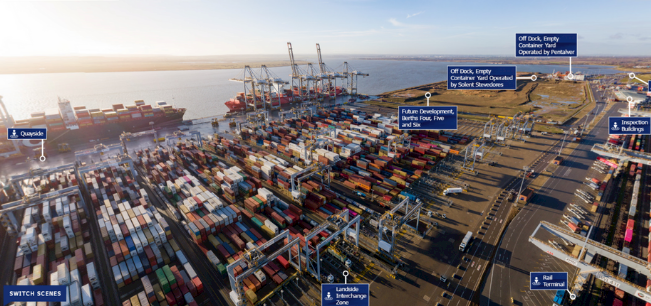
One contributor that may have exacerbated issues at London Gateway is construction on DP World’s $1.3 billion berth expansion project,. This massive investment will ensure an additional 450,000 TEU of yearly handling capacity when it’s completed in 2030. Until then, factors like reduced working areas will necessitate some negative impacts on reliability and capacity, as mega construction projects can be expected to do.
High average congestion at London Gateway
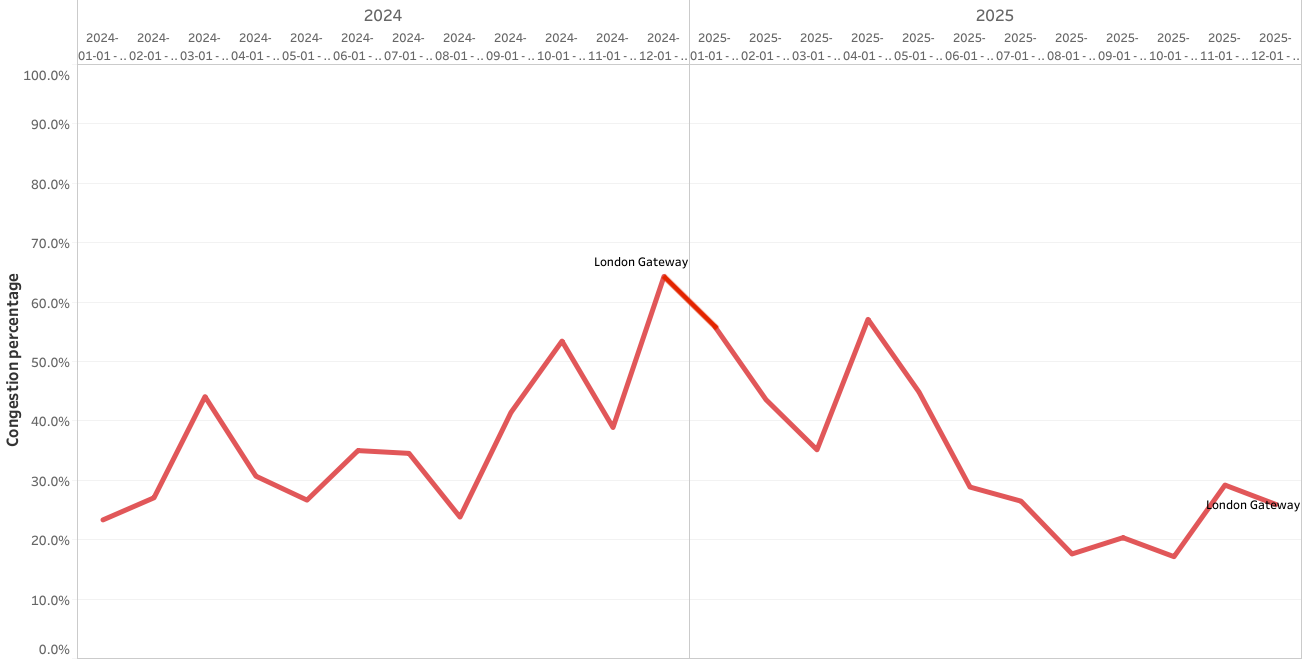
With Asia-Europe services making longer voyages past the Cape of Good Hope and their larger vessels requiring increased handling times, it’s no surprise that London Gateway’s average congestion was already soaring between 40-60% from Q3 2024 through February 2025. When monthly congestion peaked at 57% in April and construction on the berth expansion began, it added further strain on vessel wait times. Then in June and July, a series of IT and power outages, along with a rail incident, led to a massive container backlog.
Average monthly congestion at London Gateway - 2025
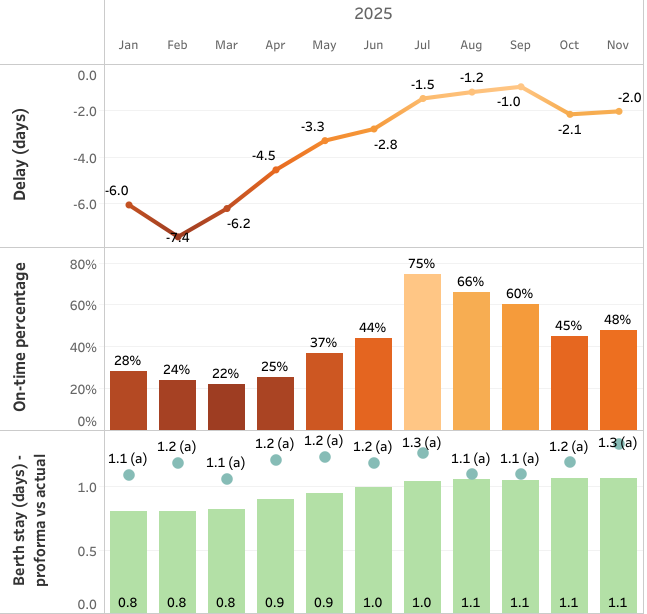
It may seem counterintuitive, but this led to an immediate respite in poor reliability. On-time percentage jumped from 44% in June to 75% in July, and delays decreased from an average –2.8 to –1.5 days delayed. This improved reliability was sustained throughout Q3 before dropping back down to 45% of on-time arrivals in October, and has remained below 50% since.
A dramatic resurgence in reliability despite of struggling
How can a struggling port experience a dramatic resurgence in reliability? The reason reveals the complexity of relationships between reliability, capacity, and congestion - and why nothing should be taken at face value. So many services were quick to scale back and omit calls to London Gateway that it provided immediate relief to these back-to-back disruptions, but at a huge cost.
*Note: Displayed values in this static image are limited to actual capacity represented by bars, while the line represents expected capacity.
Rapidly these losses outpaced the rate of growth
London Gateway has suffered 2 million TEU of absolute lost capacity year-to-date. That’s a sizeable 58% increase against 2024, and a stunning 480% increase in lost capacity against 2023. Comparing that to the year-over-year expected capacity growth of +11% in 2024, and +18% in 2025, we can illustrate just how rapidly these losses outpaced the rate of growth. If we go ahead and discount ‘gains’ like month-over-month rolling vessel delays and inducements (aka unplanned calls), the port racked up 2.16 million TEU’s of capacity due to omissions alone in 2025.
Trade capacity index (TCI) at London Gateway - 2025
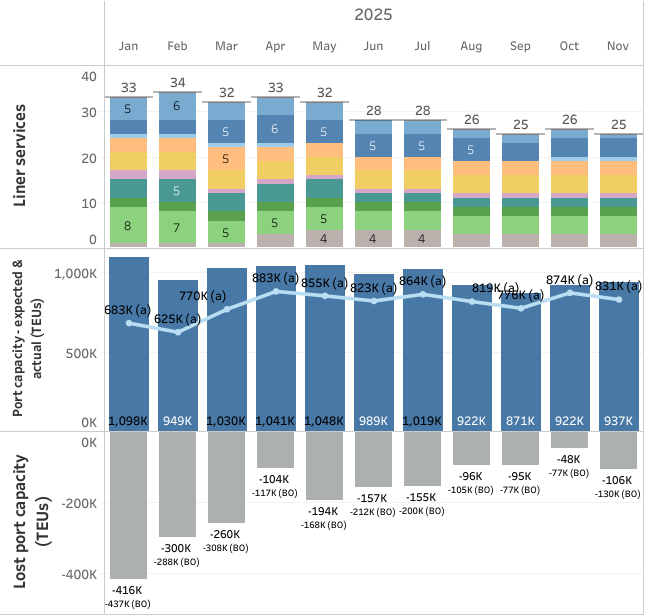
Many London Gateway services impact
While many London Gateway services rerouted to Southampton or Felixstowe in short bursts during the height of delays, others have extended what initially began as temporary rotation adjustments well into 2026. From May through December, structural service changes have contributed to a decline from 32 to 25 strings, or 28% of the port's services. The reason we avoid including Q1 in this calculation is that the combination of old and new alliance services operating simultaneously during the turnover period would unfairly skew this decline in an even more negative light.
Some services like MSC’s Middle East IPAK string cleverly maintain both Felixstowe and London Gateway calls in order to diversify options and mitigate risks. But strategies can range even for the same carrier; MSC’s West Africa NWC MOR WAF service has omitted calls to London Gateway a total of 25 times in the past year and continues to do so on a regular basis. These measures are being taken despite the port still holding a key position in the string's rotation as the first port of discharge.
Average monthly congestion at major UK ports - 2025
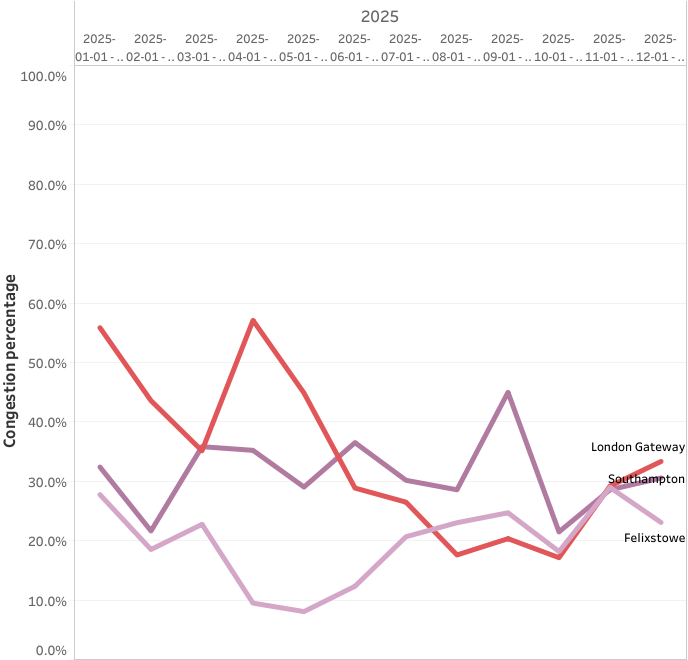
Collateral congestion aside, Southampton could very well attribute some diverted traffic to their throughput growth this year. Felixstowe’s actual capacity has seen a modest 3% YoY growth, compared to a 5% increase in 2024. Southampton however, has seen a very notable 29% growth in actual capacity so far, compared to a -3% YoY decline in 2024. The reason we default to actual instead of expected capacity here, is that it enables us to include capacity delivered via inducement calls. If we look at how these three measure up in terms of planned port calls; London Gateway lost 22% of expected port calls, Southampton lost 11%, and Felixstowe lost just 3% of expected arrivals.
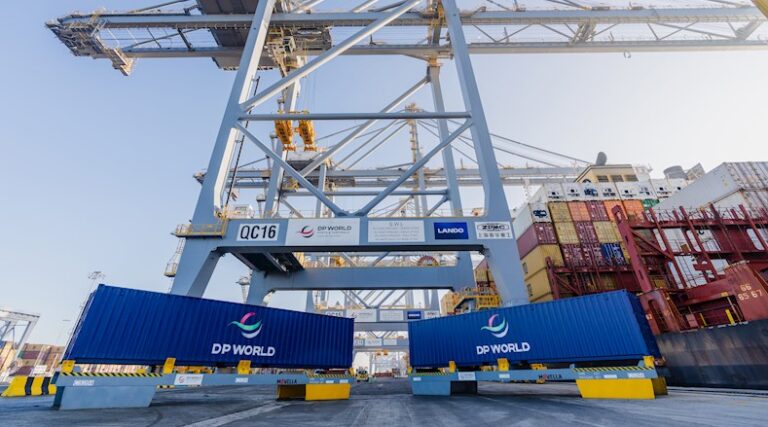
London Gateway : Expansion work began last May 2025
On the other hand London Gateway, a deep-sea port some 48 kilometers east of Central London operated by UAE-based logistics heavyweight DP World, is set to undergo major construction works as a £1 billion ($1.3 billion) expansion project nears its commencement date. As per DP World, Expansion work began last May 2025 and is expected to take four years to complete. Estimates are that this could ‘significantly’ increase the capacity of the port and ‘bolster’ the UK’s maritime infrastructure. Simultaneously, the UAE-headquartered logistics player said that the endeavor could establish London Gateway as a “critical hub” for boosting the UK’s trade capability.
As part of the investment, DP World revealed that a second rail terminal would be built, as well, to manage the anticipated rise in container traffic. It is understood that, by the project’s end, the port’s 2.5-kilometer quayside would boast the capacity to accommodate six of the world’s largest boxships at the same time In addition to this, representatives from DP World have noted that the expanded container port would be served by ‘Europe’s tallest quay cranes.’
DP World London Gateway
DP World London Gateway is the UK’s most advanced, connected and integrated logistics hub. We bring the world’s biggest ships back to London and closer to the largest consumer markets in Western Europe. Its highly productive deep-water berths are built to handle the world’s largest vessels and its state-of-the-art technology means that it can do this in the safest, most reliable and efficient way
Advanced automated technology provides market leading turnaround times for maximum efficiency. As does onsite inspection facilities with clearance taking just three days on average.Offering the UK’s best tidal access, largest port rail terminal, and easily accessible road connections across the country, there’s resilience to keep your supply chain moving.
Related : DP World unites Marine Services Brands under One Global Identity
#DP World London Gateway , #Xeneta , #A challenging year , #Destine Ozuygu , #Cape of Good Hope #Expansion of the London gateway , #ports Southampton
You Might Also Like

Recommendation News
Marine Tech
Container ship demolitions at an all-time low stands at 28 years 15 October 2025
Marine Tech
ABS Approves Ammonia Cracking Technology for Ships 14 October 2025
Incidents
Another incident within hours : Three Killed on Maersk container ship in Malaysian Due to a fire 10 November 2025
Marine Tech
MBF and ZESTAS sign MoU To accelerate zero- emission 11 October 2025
Incidents
US : Drugs worth nearly half a billion dollars seized 16 October 2025