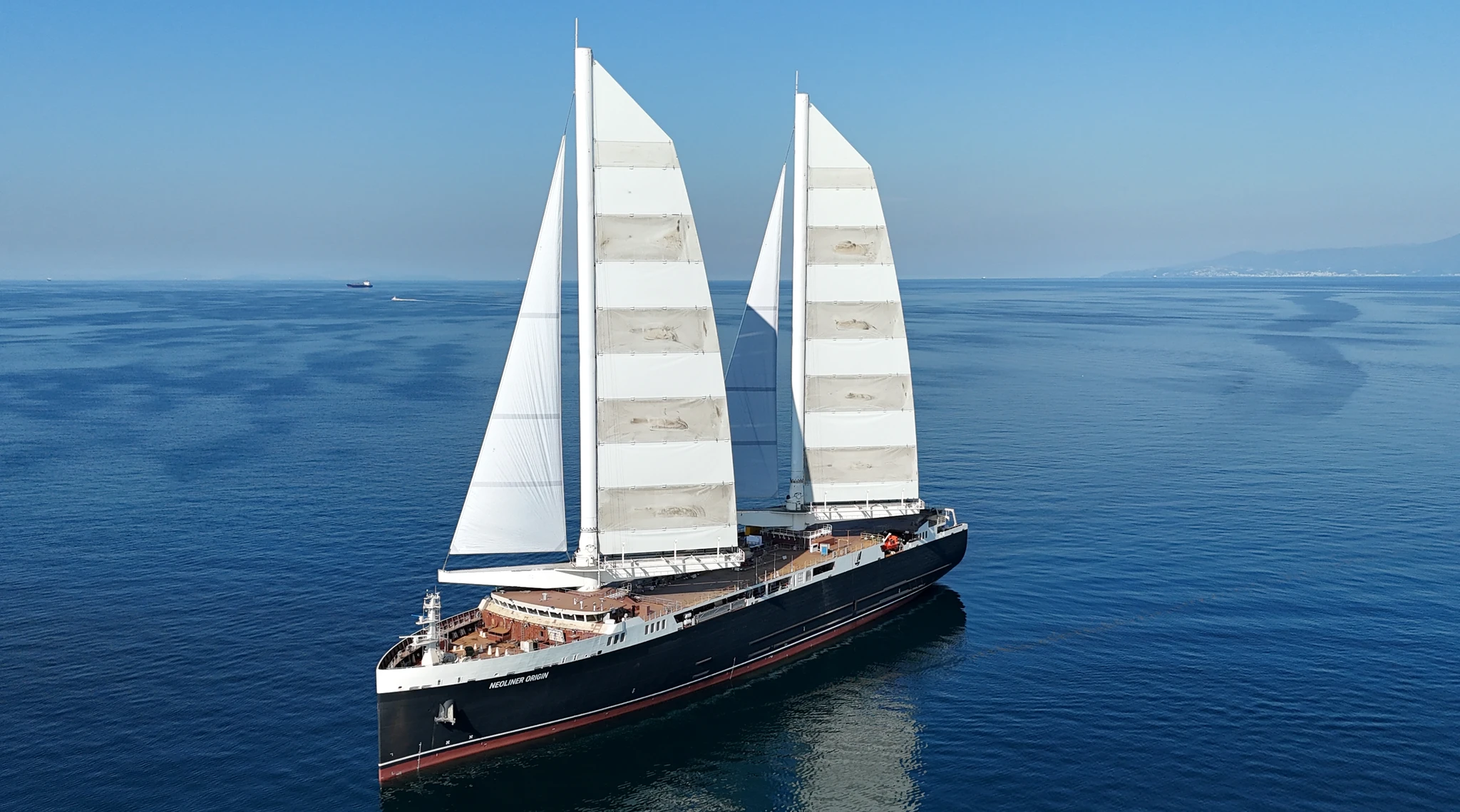
The study finds that using sailing vessels under 500 Gross Tons (GT) is the optimal approach for the sail freight industry,
The Center for Post-Carbon Logistics, Inc. (CPCL) recently published a clear and compelling overview of the state of sail freight in the United States — and how this emerging sector can meaningfully reduce emissions while strengthening local economies. Read a summary here, and The Sail Freight Business Handbook can be downloaded here as a pdf.
The center for Post Carbon Logistic
CPCL ( The center for Post Carbon Logistic ) is a 501 C 3 nonprofit dedicated to engineering, educating, and advocating for the revival of near-zero emission merchant vessels and small ports primarily in Northeastern U.S. Our focus is simple: replace trucks with short-sea shipping where sail freight offers the highest emissions-reduction potential due to heavy congestion and inefficiencies on regional highways.
Mapped the ecosystem around the Schooner Apollonia.
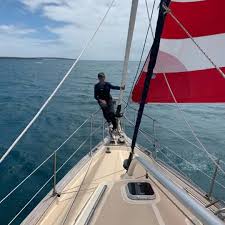
At present, the U.S. has only one active cargo-carrying sailing vessel — the Schooner Apollonia. CPCL has mapped the ecosystem around this pioneering ship and developed a replicable, competitive business model for short-distance, high-frequency freight routes.
Research team
The Sail Freight Business Handbook was compiled by a team of three Sustainable Innovation MBA (SI-MBA) graduates from the University of Vermont Grossman School of Business (UVM GSB) including Steven Woods, CPCL’s Director of R&D, and Board member Elliot Stevenson. It has been designed to provide entrepreneurs and advocates with the fundamental business analysis and route identification tools to bring CPCL’s goal of increasing, year-round near-zero-emission coastal maritime trade in the United States. By covering the fundamentals of business logic, financial analysis, carbon emissions, and route selection criteria, this report gives the foundation for building a near-zero-emission coastal short sea shipping fleet in the Northeast U.S

Cost stability
A major insight from the research: sail freight wins through cost stability, not by being the cheapest option. While trucking prices fluctuate constantly, the fixed-cost nature of sail freight allows operators to offer a predictable yearly rate—something businesses increasingly value. The study finds that using sailing vessels under 500 Gross Tons (GT) is the optimal approach for the sail freight industry, with a focus on local routes where a cost leader or cost stabilization strategy can be used to compete with trucking.
The team has identified routes where sail freight can already compete, or even lead, on price. Examples include Boston–Provincetown and New Bedford–Martha’s Vineyard, where sail freight can cut costs nearly in half while removing hundreds of tons of CO₂ annually.

Timeline and scaling
To scale this movement, CPCL is developing:
- A pallet-sized microcontainer system for ship–bike logistics
- Modular port infrastructure for small coastal communities
- A suite of open-source sail freight vessel designs
- Sail freight training curricula and “workforce development.”
A clear timeline is taking shape: microcontainer prototypes and modular port design by Spring of 2026, and the first new open-source vessels on the water by 2027 — funding permitting
Conclusion
The Handbook concludes that sail freight can be competitive in the transportation industry in the Northeast US, so long as it is technically compatible with existing transportation systems. Route selection, capacity matching, and a strategy appropriate to the economic and geographic environment of a route are critical to success. Having multiple routes of varying profitability all under one umbrella company to cross-subsidize marginal routes is also recommended as a way of rapidly expanding a regional sail freight network. To support the work of the Center for Post Carbon Logistics, the publication and wide distribution of the Sail Freight Business Handbook please click here.
Source : Press - Release received by Maritime Tickers
#CPCL #Sail Freight Business Handbook #Schooner Apollonia#Steven Woods #Elliot Stevenson#Northeast U.S
You Might Also Like
Recommendation News
Marine Tech
CESMA calls for new standards for ship documentation and SOLAS 14 October 2025
Marine News Room
Dr Bassir :The recent discovery of a 2,000-year-old ancient pleasure vessel off the coast of Alexandria a major milestone 09 December 2025
Marine Tech
Bulgarian Shipowners Association joins ICS as an Affiliate Member 18 June 2026
Shipping Lines
Noble Corporation plc to announce fourth quarter and full year 2025 results 05 February 2026
Ports
Antwerp chemical firms test water reuse 03 April 2026