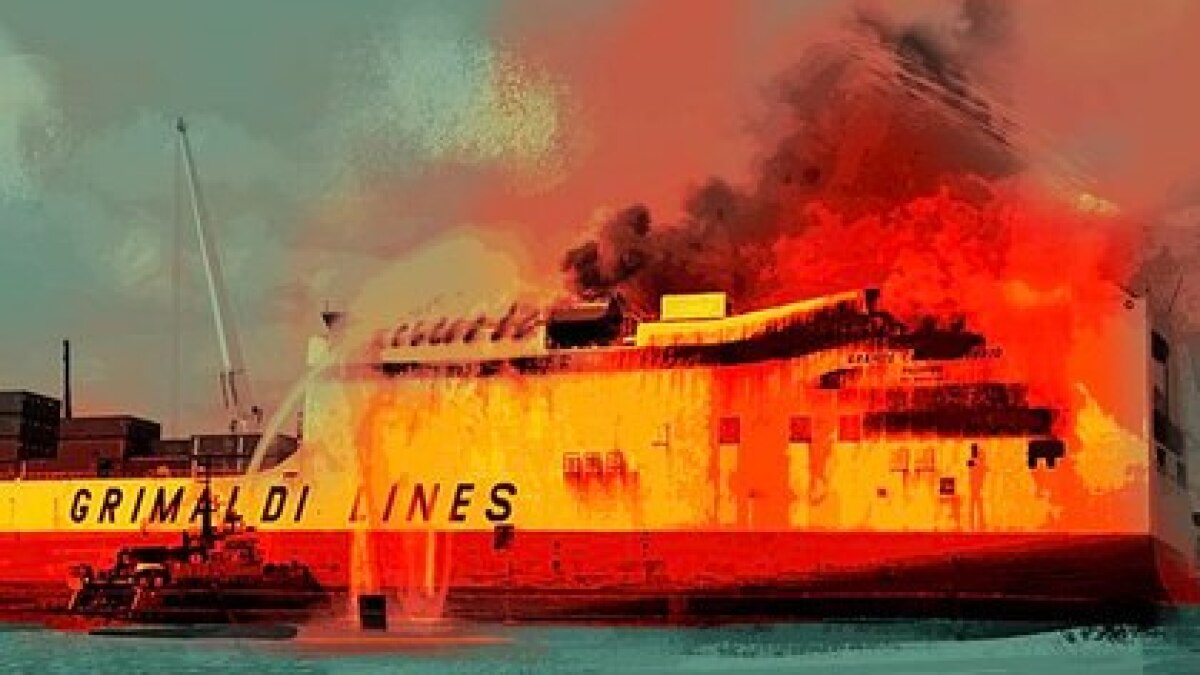
Investigations into the 2023 Grimaldi con-ro ship accident concluded: port company responsible and local firefighters seriously at fault
Newark ship fire that killed 2 firefighters caused by improper vehicle
The Newark ship fire that killed two firefighters in 2023 was caused by crews using an unsuitable vehicle to push cars onto the ship, federal investigators said
The National Transportation Safety Board recommended Tuesday that land-based firefighters be better prepared for marine vessel firefighting following a fatal fire on the roll-on/roll-off container vessel Grande Costa D’Avorio in Newark, New Jersey.
The NTSB found that directing firefighters to enter the area where the CO2 extinguishing system had been activated, contrary to general marine firefighting convention, exposed firefighters to additional and unnecessary risk. The Newark Fire Division was also not adequately prepared to respond to a vessel fire and lacked marine vessel firefighting training.
The Grande Costa D’Avorio was docked at Port Newark
The Grande Costa D’Avorio was docked at Port Newark on July 5, 2023, when a vehicle used by shoreside workers to push used vehicles onto the vessel caught fire on an interior garage deck. The ship’s captain ordered use of the vessel’s carbon dioxide extinguishing system, but the crew was unable to close a large rampway door because the control panel was located inside the fire protection zone (where the carbon dioxide would be released).
The lack of operating controls
The lack of operating controls on the outside of the door prevented the crew from safely closing the door and directly led to the ineffectiveness of the fire extinguishing system, contributing to the fire’s duration and severity.
Two land-based firefighters died
Two land-based firefighters died while attempting to put out the fire. Six additional emergency responders were injured during the firefighting and rescue operations. The damage to the vessel was estimated to be over $23 million.
Carry thousands of used cars
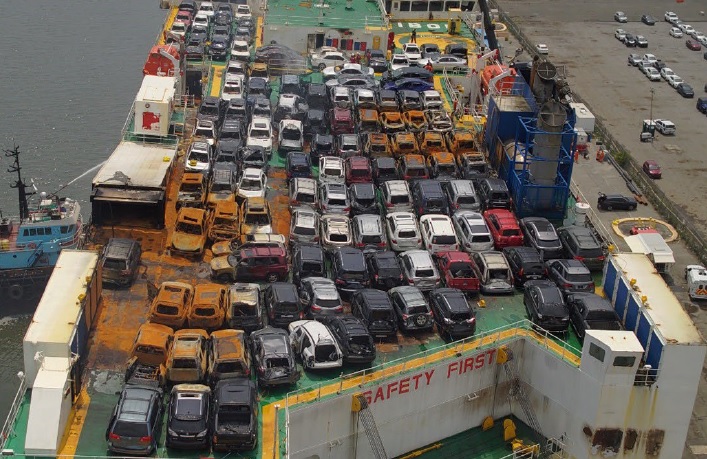
Grimaldi RORO vessels like the Grande Côte d’Ivoire carry thousands of used cars from the United States to Africa, including vehicles so damaged they cannot move and non-functional vehicles that must be pushed aboard.
Investigators found
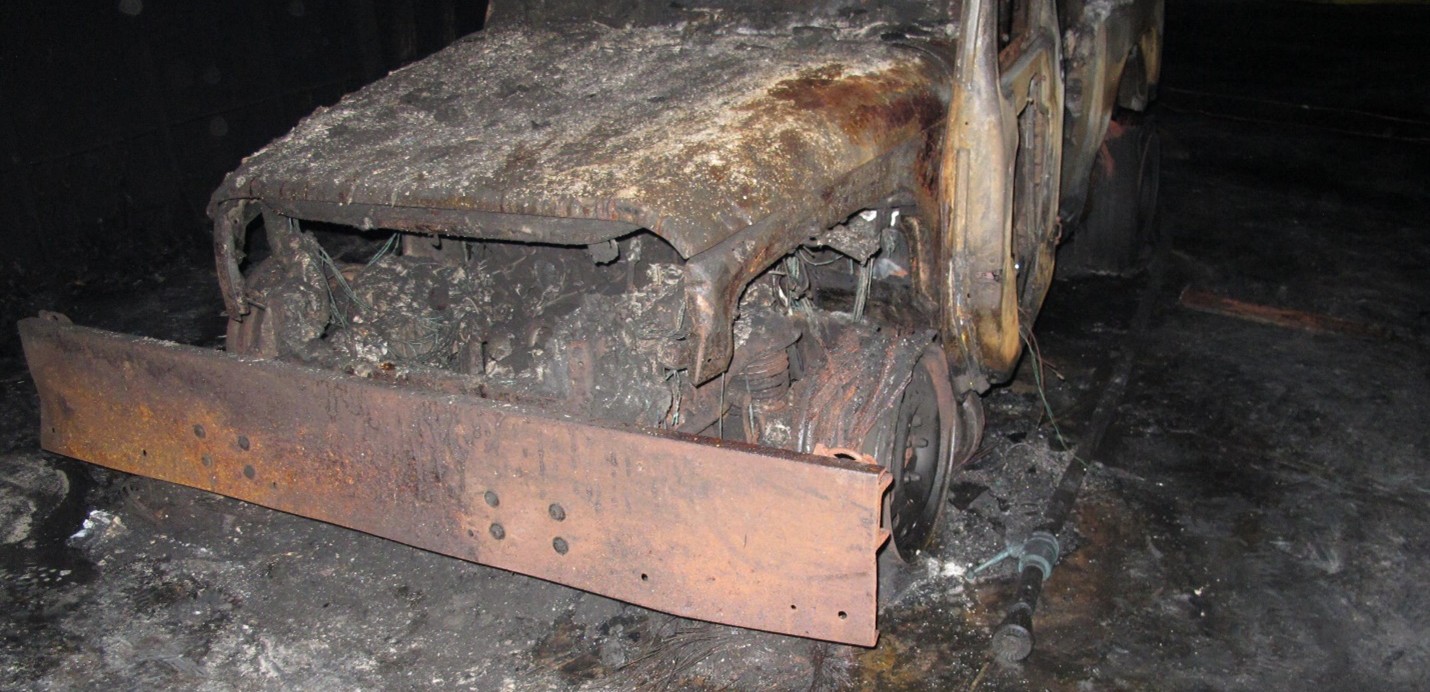
Investigators found the vessel fire resulted from the overheated transmission fluid of the pusher vehicle, a 2008 Jeep Wrangler, which boiled over and ignited on a hot engine surface. The Jeep was a passenger vehicle, and not suitable for use as a power industrial truck because it did not meet Occupational Safety and Health Administration, or OSHA, standards for a power industrial truck.
The vehicle that caught fire
The vehicle that caught fire was a Jeep Wrangler, and the NTSB noted that it was being used for an unintended industrial application. This particular model of vehicle was recalled because its transmission was prone to overheating under extreme misuse.
On the day of the fire
On the day of the fire, the Grande Côte d’Ivoire was loading 920 used cars for export, including those not in service. At about 9 p.m., security cameras show, a longshoreman was driving the Wrangler on his 38th push of the day on theRo-Ro’s internal ramps, a task far more demanding than expected. He was pushing a non-running vehicle when he heard a thump and saw “fireballs” dripping from underneath the vehicle.
Procedural protocols
Based on procedural protocols for the use of the Jeep, evidence collected on site, and the extreme duty cycle imposed on the Jeep, the NTSB concluded that the accident was caused by the decision to operate a vehicle not designed for that purpose, resulting in transmission oil overflowing and subsequent fire upon contact with hot engine parts.

Recommendations to the Port Authorities
The NTSB also made recommendations to the Newark Fire Division and the Port Authority of New York and New Jersey, the American Association of Port Authorities, the International Association of Firefighters, the International Association of Fire Chiefs, and the National Volunteer Fire Council, to improve land‑based firefighting departments’ marine vessel firefighting training and familiarity.
Develop policies for emergencies
To ensure that shoreside personnel are aware of what to do in the event of a fire on board a vessel, the NTSB recommended that Ports America and American Maritime Services develop policies for emergencies, including accounting for all employees.
A recommendation to Grimaldi
In addition, the NTSB made a recommendation to Grimaldi Deep Sea, the ship owner, to inventory all their vessels to identify all openings that are part of a fire boundary and modify their vessels so that the openings are capable of being closed from outside the protected space.
RINA Services
The NTSB also recommended that RINA Services, the vessel classification society, revise their procedures for review and approval of vessel plans to ensure that fire boundary openings to spaces protected by fixed gas fire extinguishing systems can be closed from outside the protected space.
Convention for the Safety of Life at Sea
The NTSB also recommended that the U.S. Coast Guard submit a proposal to the International Maritime Organization to clarify the International Convention for the Safety of Life at Sea regulation requiring that all openings capable of admitting air into or allowing gas to escape from a protected space can be closed from outside the protected space applies, regardless of their expected operational condition when in port or at sea.
Related : Another Grimaldi Ship Catches Fire !

It is noteworthy that Acabou and Brooks died after getting lost on the ship. Newark firefighters were sent in even though all 28 crew members had been safely evacuated and accounted for.
“I hope that Newark fire department leadership is listening,” National Transportation Safety Board Chairwoman Jennifer Homendy said. “This isn’t just a failure of communication. This was a failure of leadership.”
The NTSB found that most local first responders had not taken recent marine firefighting courses and were unfamiliar with the ship’s firefighting plan or CO2 flooding systems. Newark’s local fire department should never have entered the deck to fight the fire: “The best method of extinguishing the fire would have been to work with the crew to close the door to deck 12 and allow the CO2 system to operate.”
Source : Italian Media
Related : US Coast Guard, Navy Seize Nearly 1,300 Pounds of Cocaine
The Grande Avorio fire ,a Jeep Wrangler , The NTSB ,RINA Services ,Jennifer Homendy , Convention for the Safety Grimaldi Deep Sea,
You Might Also Like
31 October 2025

02 December 2025
Recommendation News
Ports
Expo “all about ports” Hamburg Messe und Congress 06 December 2025
Marine Tech
ABS and Fleetzero to Advance Battery Containers for Maritime Applications 15 January 2026
Incidents
Collision for Two Grimaldi Ships in Igoumenitsa Port (VIDEO) 17 October 2025
Marine Tech
BIMCO adopts FuelEU Maritime and ETS clauses for ship sale contracts 13 December 2025