
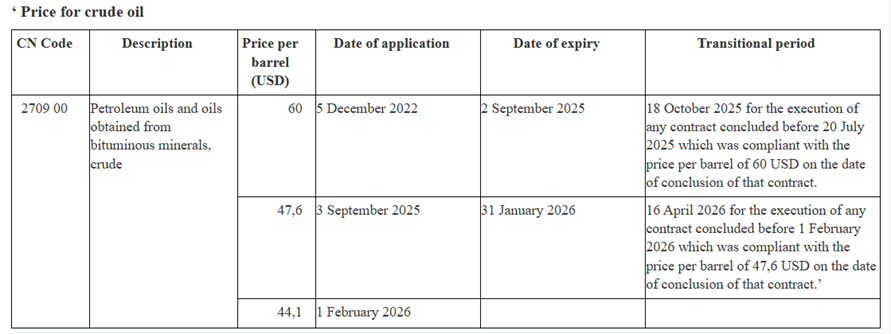
The European Union will reduce the price cap on Russian crude oil from $47.6 to $44.1 per barrel as of February 1, 2026, according to documentation released by the European Commission. The new level will apply from Feb. 1, 2026, replacing a $47.6-per-barrel cap that has been in force since Sept. 3, 2025.It is noted that the price cap on Russian oil was first set on December 5, 2022. At that time, it was $60 per barrel.
Today, the new automatic and dynamic mechanism for price adaptation of the Oil Price Cap for Russian crude will be applied for the first time. The new price cap for Russian crude oil is $44,10 per barrel, effective 1 February. Starting 15 January, old contracts concluded under the previous price cap can be executed for 90 days.
The 18th sanctions package
Under the 18th sanctions package the cap was lowered from $60,00 to $47,60 with an automatic and dynamic mechanism introduced to set the future price cap for crude oil. The new mechanism ensures that the cap is always 15% lower than the average market price for Urals crude in the previous reference period (22 weeks).
The transition period
The transition period with a price of $47.6 per barrel for Russian oil will remain in effect until April 16, 2026, for the execution of any contract concluded before 1 February 2026.“That transition period is necessary to ensure the consistent implementation of the price cap by all operators,” the document says. Last year, the European Union lowered this cap to $47.60 per barrel.
The new price cap for Russian crude oil
The new price cap for Russian crude oil is $44,10 per barrel, effective 1 February. Starting 15 January, old contracts concluded under the previous price cap can be executed for 90 days. The price cap will be subject to regular review every six months by the European Commission, although extraordinary reviews are possible where duly justified by developments in the oil markets or other unforeseen circumstances.
The G7 Oil Price Cap Coalition
The Commission is in regular contact with EU member states, as well as with international partners, to ensure close coordination on the measures. The G7 Oil Price Cap Coalition established an oil price cap mechanism on Russian seaborne crude oil and petroleum products in 2022.
An oil price cap mechanism on Russian seaborne crude oil
The G7 Oil Price Cap Coalition established an oil price cap mechanism on Russian seaborne crude oil and petroleum products in 2022. EU operators are only allowed to provide maritime transport and related services for Russian crude oil and petroleum products if sold at or below the relevant price caps. This mechanism was specifically designed to put further pressure on Russia's oil revenues, while keeping global energy markets stable through continued supplies.
EU operators are only allowed to provide maritime transport and related services for Russian crude oil and petroleum products if sold at or below the relevant price caps. This mechanism was specifically designed to put further pressure on Russia’s oil revenues, while keeping global energy markets stable through continued supplies.
Related : Reuters : Drones hit two tankers in Black Sea as Kazakh oil production plummets
Source : Agencies
#Oil Price Cap #The G7 #Russian crude oil #The European Union #European Commission #Coalition
You Might Also Like


Recommendation News

Yachts&Cruises
Josh Hyde and Waitematā Racing Secure 2nd Place at the USA Grand Slam – Oakcliff International 07 September 2026
Yachts&Cruises
GULF CRAFT Celebrated For Its Outstanding Commitment To Elevating UAE Employment Standard 20 November 2025
Ports
Antwerp chemical firms test water reuse 03 April 2026
Marine Tech
Wärtsilä Lifecycle Agreement ensures reliable performance and efficiency for 12 new LNG carriers 16 January 2026
Marine Tech
Egypt : Construction begins on two new Dry Bulk carriers to modernize the NNC fleet. 05 December 2025