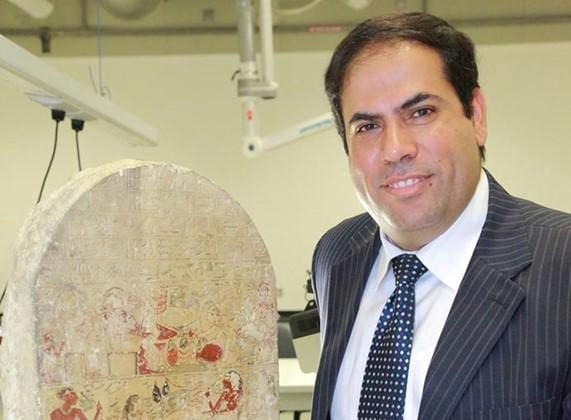
Dr Bassir :These finds demonstrate that Alexandria’s ancient waterfront was not merely a port, but a vibrant ceremonial and political stage—a living theater of power, religion, and culture.
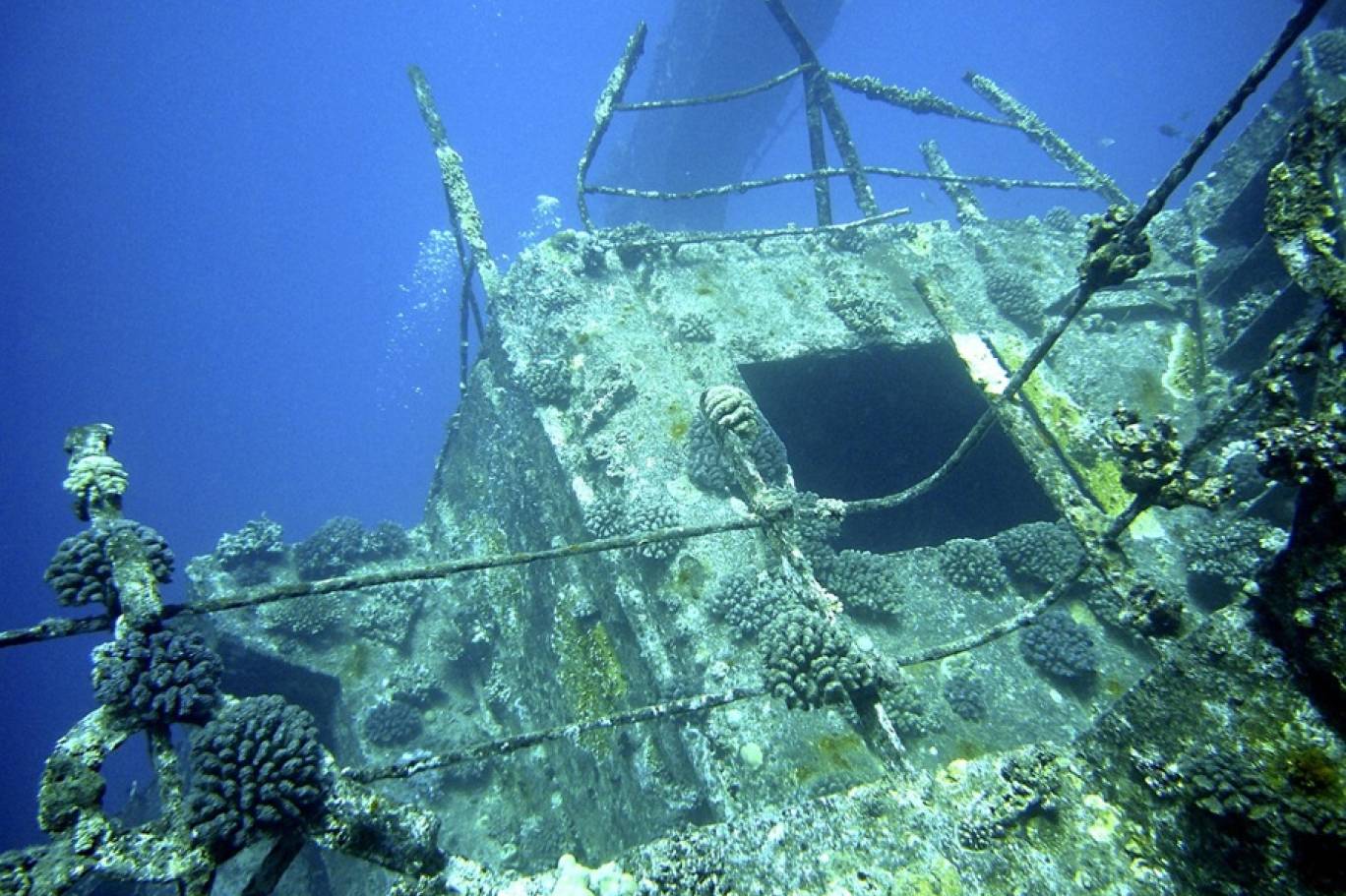
An ancient Egyptian pleasure boat that matches a description by the first-century Greek historian Strabo has been discovered off the coast of Alexandria, to the excitement of archaeologists. according to The Guardian
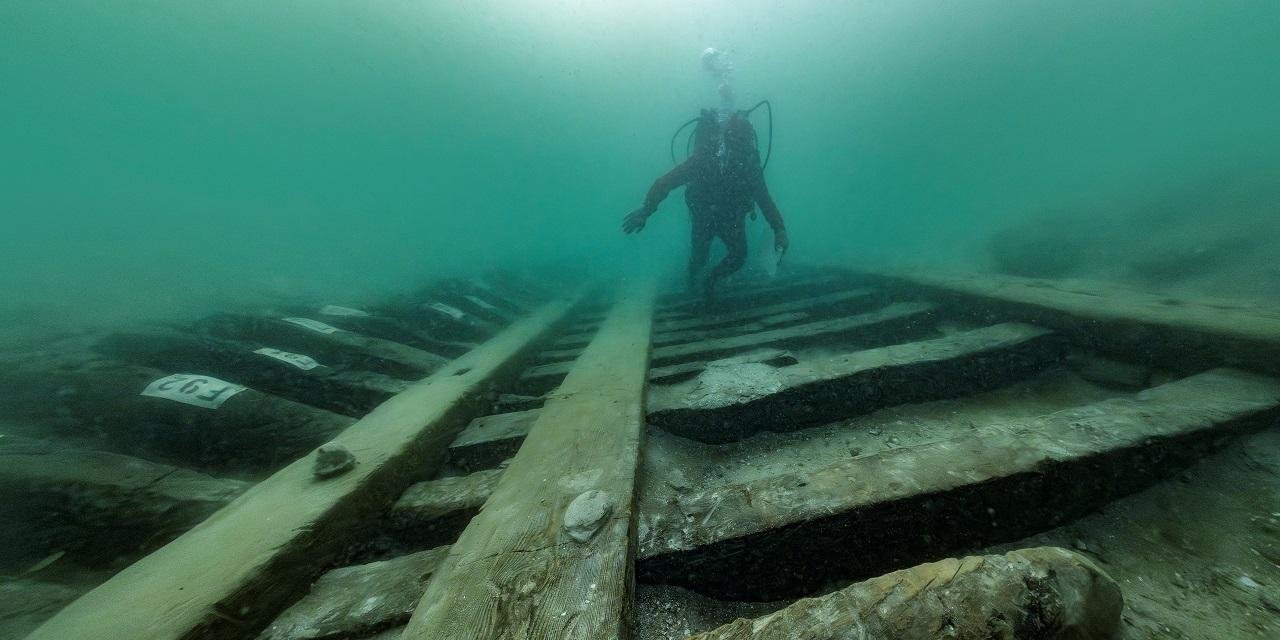
With its palaces, temples and the 130 metre-high Pharos lighthouse – one of the seven wonders of the ancient world – Alexandria had been one of the most magnificent cities in antiquity. The pleasure boat, which dates from the first half of the first century AD, was 35 metres long and constructed to hold a central pavilion with a luxuriously decorated cabin.It was discovered off the submerged island of Antirhodos, which was part of ancient Alexandria’s Portus Magnus (great port).
These vessels are luxuriously
Strabo had visited the Egyptian city around 29-25BC and wrote of such boats: “These vessels are luxuriously fitted out and used by the royal court for excursions; and the crowd of revellers who go down from Alexandria by the canal to the public festivals; for every day and every night is crowded with people on the boats who play the flute and dance without restraint and with extreme licentiousness.”
The European Institute for Underwater Archaeology (IEASM)
It is noteworthy that The excavations were conducted by the European Institute for Underwater Archaeology (IEASM) under the direction of Franck Goddio, a visiting professor in maritime archaeology at the University of Oxford.It had been lying only 7 metres under the water and 1.5 metres under the sediment. Goddio’s initial assumption was that there were two ships on top of one another “because the construction type was so strange”. He added: “The bow is flat … and the stern is round … to be able to navigate in very shallow water.”
The extraordinary maritime culture of this historic city. Alexandria

On the other hand Dr. Hussein Bassir, Egyptian Egyptologist and Director of the Antiquities Museum at the Library of Alexandria told " Maritime Tickers : The recent discovery of a 2,000-year-old ancient pleasure vessel off the coast of Alexandria represents a major milestone in our understanding of Roman Egypt and the extraordinary maritime culture of this historic city. Alexandria has always occupied a unique position in the ancient world—a meeting point where Egyptian traditions, Hellenistic intellectual life, and Roman administrative power merged to create a civilization of exceptional brilliance. The newly uncovered ship, with its impressive length of more than 35 meters, its elegant hull, its luxurious interior decorations, and the Greek inscriptions carved upon its timbers, vividly reflects the sophistication and cosmopolitan nature of Alexandrian life during the early Roman period. Noted Alexandria has always occupied a unique position in the ancient world—a meeting point where Egyptian traditions, Hellenistic intellectual life, and Roman administrative power merged to create a civilization of exceptional brilliance.
The ship’s architectural features
Dr. Hussein Bassir emphasized to Maritime Tickers : Finds such as this allow us to recreate a world that once flourished along the shores of the ancient Eastern Harbor. The ship’s architectural features suggest that it belonged to the class of ceremonial or pleasure boats used by the elite for processions, festivities, and social gatherings upon the calm waters of the harbor. Its construction techniques and stylistic choices also reinforce what we know from ancient writers such as Strabo, who described Alexandria as a city where the sea, the royal quarter, and the monumental temples formed an interconnected cultural landscape of splendor and innovation.
He indicated in his exclusive press statements : This discovery is not an isolated event, but rather part of a long and fascinating archaeological journey that began with the identification of the submerged island of Antirhodos in the 1990s. Over the years, underwater explorations have revealed palatial structures, colonnades, statues, ceremonial objects, coins, jewelry, and large architectural blocks belonging to temples dedicated to deities such as Isis and Serapis. Together, these finds demonstrate that Alexandria’s ancient waterfront was not merely a port, but a vibrant ceremonial and political stage—a living theater of power, religion, and culture.
He noted : The newly found ship adds an essential dimension to our understanding of life in Roman Alexandria, shedding light on the nature of leisure, ritual, and transport in a city whose identity was deeply tied to the sea. Its discovery enriches our knowledge of ancient shipbuilding and maritime technology, and offers a rare opportunity to study the luxurious lifestyle of the Alexandrian elite at a time when the city was at the height of its intellectual and economic influence.
He highlight to Maritime Tickers : This magnificent archaeological achievement also forces us to confront a critical reality. Alexandria today is facing some of the most serious environmental threats of any coastal city in the Mediterranean. Rising sea levels, coastal erosion, and land subsidence are pressing challenges that have already begun to alter the city’s physical landscape. Scientific assessments indicate that, within a few decades, significant portions of Alexandria may become vulnerable to flooding or may even prove uninhabitable if urgent preventative measures are not taken.
The discovery is a call to action for the future.
He said, astonished and surprised : The irony is striking: the same sea that once supported the prosperity of ancient Alexandria and now preserves its sunk treasures for us to rediscover, is also the sea that threatens its modern existence. This duality obliges us to adopt a comprehensive vision for safeguarding the city—one that integrates archaeological preservation with urban planning, environmental science, and long-term sustainable development.
Dr.Hussein Bassir concluded his exclusive statements to the Maritime Tickers saying .The discovery of this ancient vessel is therefore not only a window into the past but also a call to action for the future. It reminds us of that Alexandria, a city that has stood for more than two millennia, deserves our unwavering commitment to protect its cultural heritage and its living communities. Through responsible environmental stewardship, careful archaeological research, and an appreciation for the city’s unique historical role, we can ensure that Alexandria continues to thrive—both as a guardian of ancient memory and as a vibrant cultural center for generations to come.
Dr.Hussein Bassir ,An ancient Egyptian pleasure boat ,(IEASM) , first-century Greek historian , Roman Egypt , Alexandria coast
You Might Also Like

03 February 2026
31 August 2026
Recommendation News

Marine Tech
RINA has approved SRC's Methanol Superstorage system. 23 April 2026
Shipping Lines
GEODIS in Switzerland strengthens its healthcare capabilities and expands its national footprint 08 April 2026

Marine Tech
LR strengthens submarine assurance capability with expanded structures framework 29 July 2026
Ports
Syrian ports are a " Magnet Point" for global investment today. 30 November 2025