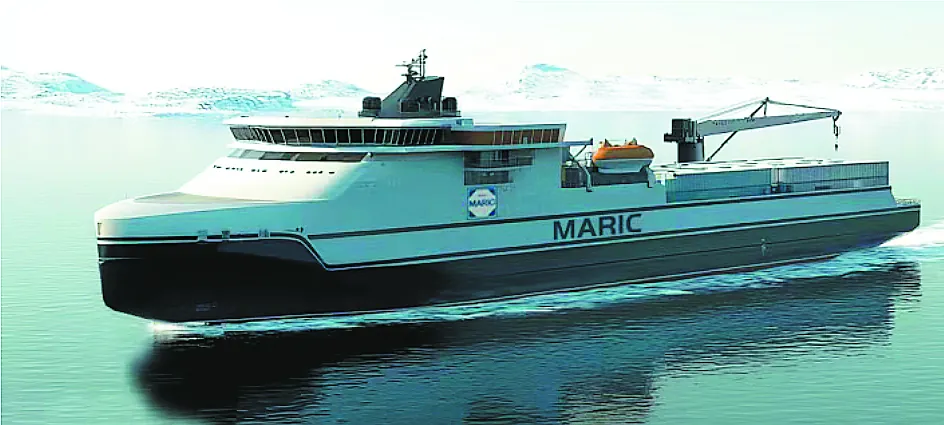
The nuclear-powered passenger-cargo icebreaker, accommodate approximately 150 tourists heading to the Arctic while maintaining significant cargo capacity
China State Shipbuilding Corporation has unveiled the concept for a nuclear-powered icebreaker, which has already received an "Approval in Principle" (AIP) from RINA, placing the project in a more concrete context than mere preliminary studies. The vessel was developed by the Marine Design and Research Institute of China with the aim of operating on Arctic routes for both seasonal cargo transport and the growing tourist shipping market. The announced dimensions are 165 meters in length, 30 meters in beam, and approximately 30,000 tons of displacement, placing the vessel among the large icebreakers
Ship design
According to the the nuclear-powered passenger-cargo icebreaker, accommodate approximately 150 tourists heading to the Arctic and up to 250 people overall, while maintaining significant cargo capacity: the modular hold can accommodate up to 300 20-foot containers and even oversized cargo. The choice to combine commercial and hospitality functions aims to create a platform capable of supporting multiple deployment models, from seasonal Arctic logistics to high-end luxury cruises. The declared icebreaking capacity, equal to 2.5 meters of ice thickness at approximately 3.7 km/h, places the vessel in an operational segment suitable for areas with thick and variable ice.
The technological heart of the project
The technological heart of the project is the nuclear propulsion system based on a molten salt reactor combined with a thermoelectric cycle using supercritical CO₂. This solution, according to the designers, improves efficiency and safety compared to traditional reactors, offering high autonomy and zero fuel consumption at sea. However, the use of a technology still in its infancy for naval use raises questions about reliability, maintenance, and certification requirements.
RINA's role is crucial.
In this context, RINA's role is crucial. The release of a positive preliminary assessment represents the step that allows the project to move beyond the scope of conceptual studies. It does not equate to construction approval or operational clearance, but certifies that the ship, in its general outline, can meet the structural and safety requirements recognized by the international technical community. For a civilian nuclear ship, especially one designed to operate in sensitive areas such as the polar regions, a preliminary assessment by a Western classification society is an important signal.

The operational objectives
The operational objectives outlined by the designers include seasonal transport via Arctic routes, which can reduce navigation times between Asia and Europe by approximately 30-40% compared to traditional routes via the Suez Canal. The ship is also designed for logistics activities, special missions, and polar emergencies, thanks to the autonomy guaranteed by the nuclear system and the flexibility of its interior volumes. For tourism, the design focuses on climate control, vibration control systems, and safety solutions suitable for extreme environments.
Emerging maritime corridor
Yu Yun, a researcher at the institute, said that the opening of the Arctic shipping routes has brought about a revolutionary reduction in sea voyage distances.
"As an emerging maritime corridor linking Asia, Europe and North America, the Arctic routes can cut voyage distances by 30 to 40 percent compared with the traditional Suez Canal route, significantly lowering transportation and time costs. Taking the route from East Asia to Europe as an example, the voyage distance is shortened by approximately 7,000 kilometers, and sailing time is reduced by 10 to 15 days," Yu said.
A number of issues to be resolved
A number of issues remain to be resolved: the definition of port regulations and infrastructure for the operation of civil nuclear units, the geopolitical and environmental acceptance of a new type of ship in the polar regions, and the shipyards' concrete capacity to industrialize a molten salt reactor for maritime use. The initial credibility offered by RINA's AIP does not resolve these issues, but it does pave a technical path that could lead, in the coming years, to the construction of China's first multipurpose nuclear vessel for the Arctic. This is an evolution that should be followed closely, as it could impact the future balance of northern routes and the role of nuclear technologies in civilian fleets.
Investing heavily in modernizing and expanding icebreaker
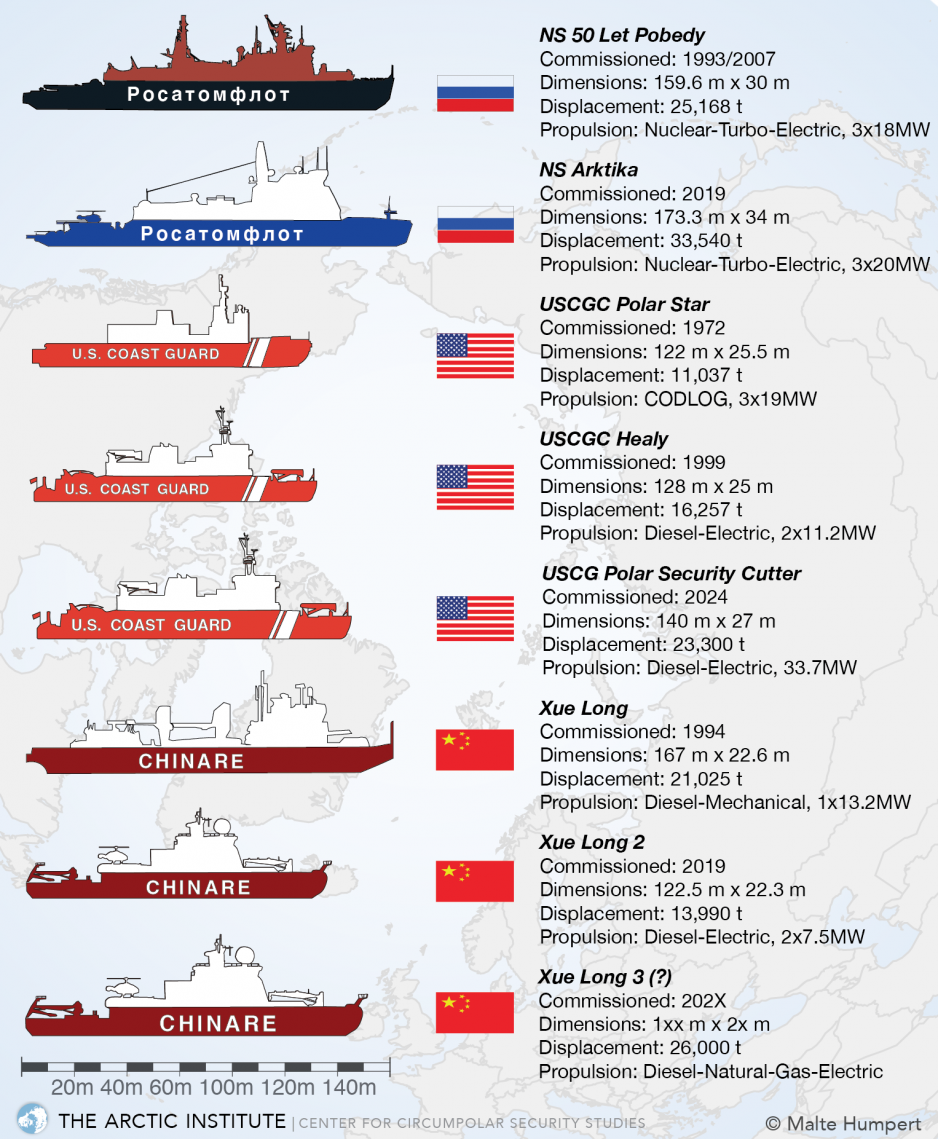
China is just one of several countries investing heavily in modernizing and expanding icebreaker capacity. Russia’s Arktika, the first in a series of at least five new nuclear icebreakers, began sea trials after more than six years of construction. In the United States, the Coast Guard has moved towards constructing and acquiring three heavy icebreakers, known as USCG Polar Security Cutter, over the next decade. Construction is scheduled to begin at VT Halter Marine’s shipyard along the Gulf Coast of Mississippi in 2021 with the first delivery in 2024.
China thus far operates two medium-powered icebreakers. The first one, Xue Long 1 (Snow Dragon) was originally constructed as an ice-class cargo ship in Ukraine in 1993 before it was purchased and outfitted by China as a polar research vessel in 1994. The country’s first home-built icebreaker, Xue Long 2, was developed in 2012 with design support from Finland’s engineering company Aker Arctic. The vessel was constructed by the Jiangnan Shipyard between December 2016 and summer 2019.
China’s Arctic White Paper
It is noteworthy that In June 2018, on the heels of China’s Arctic White Paper, The Diplomat reported on a tender issued by China National Nuclear Corporation (CNNC), the country’s largest nuclear operator, to build what would be China’s first nuclear-powered icebreaker.
The CNNC icebreaker project
The post makes direct reference to the CNNC icebreaker project: describing the ship as being designed with a displacement of “up to 40,000 tons,” and an icebreaking capability of 3 meters (up to 4.5 meters when ramming). Although not mentioning the shipyard by name, it is likely to be built by the Jiangnan Shipyard in Shanghai, as the post states that it will be built “at the same yard that recently delivered the Xue Long 2,” the country’s first domestically-built polar icebreaker. The shipyard also holds a 10 percent stake in the China Nuclear Marine Propulsion Development joint-venture that tendered for the icebreaker last year.
Shanghai Jiaotong University won the contract
It is noteworthy that Shanghai Jiaotong University won the contract. The university — which has a solid pedigree in both naval and nuclear engineering — has since joined forces with CNNC and the Shanghai Nuclear Power Office. In March 2019, the three partners opened the Research Institute for Nuclear-Powered Ships and Maritime Equipment in Shanghai. According to a press release, the institute will “serve the goal of becoming a great maritime power by developing nuclear icebreakers, nuclear-powered unmanned submersibles, floating nuclear reactors,” and other vessel types. Moreover, recent job listings for CNNC’s own nuclear propulsion research unit has included several openings for naval engineers.
Related : Report : Nuclear-powered containerships could save $68 million annually
Source : Chinese Media + Italy Media + Other sources
Chinese nuclear icebreaker , , RINA , nuclear-powered passenger-cargo icebreaker , Shanghai Jiaotong University ,Yu Yun , Xue Long 2,CNNC icebreaker project
You Might Also Like
10 December 2025

17 October 2025
Recommendation News
Shipping Lines
Tarros renews container line between La Spezia and Libya 13 November 2025
Yachts&Cruises
SilverCAT Charts New Course In The Caribbean 12 December 2025
Marine News Room
ICS & ESCA : Statement on the situation in the Straits of Hormuz 03 March 2026
Yachts&Cruises
The 36-metre Van der Valk yacht Jangada is departing for the UK. 06 April 2026
Yachts&Cruises
The 29th China Shanghai International Boat Show 29 -31 March 21 March 2026