The ocean is not a laboratory that resets itself; it is a closed biological and chemical system in which every molecule of contamination remains, circulating for decades
The maritime world stands at a threshold where speeches and declarations have lost their value. Effectiveness no longer resides in promises, but in preparedness
By Adam Laabs
Rolbatch technical director, Co-Founder w Rolbatch Laabs Academy,
Marine and Ocean Protection Technologies , Axtora Energy Co-Found
Humanity has long lived with the illusion that the ocean is too vast to be truly poisoned too immense, too self-regulating, too powerful to be fundamentally altered by human activity. This conviction remains one of the great fallacies of modern civilization. Each year, the machinery of global trade, shipping, and resource extraction releases millions of tons of oil-derived pollutants into the seas, most of which are never fully removed. The ocean is not a laboratory that resets itself; it is a closed biological and chemical system in which every molecule of contamination remains, circulating for decades.
The Invisible Presence
According to data from the International Maritime Organization (IMO) and the United Nations Environment Program (UNEP), between five and seven million tons of petroleum substances enter the world’s oceans annually. Only a small fraction comes from the large-scale disasters that make the evening news. The far greater share originates from chronic, low-level leaks corroded fittings, overflow during refueling, discharges from aging vessels, or unmonitored releases from production platforms. Their defining characteristic is invisibility. These are not catastrophic events but a continuous, unrecorded degradation of marine ecosystems, steadily eroding the ocean’s capacity for self-repair.
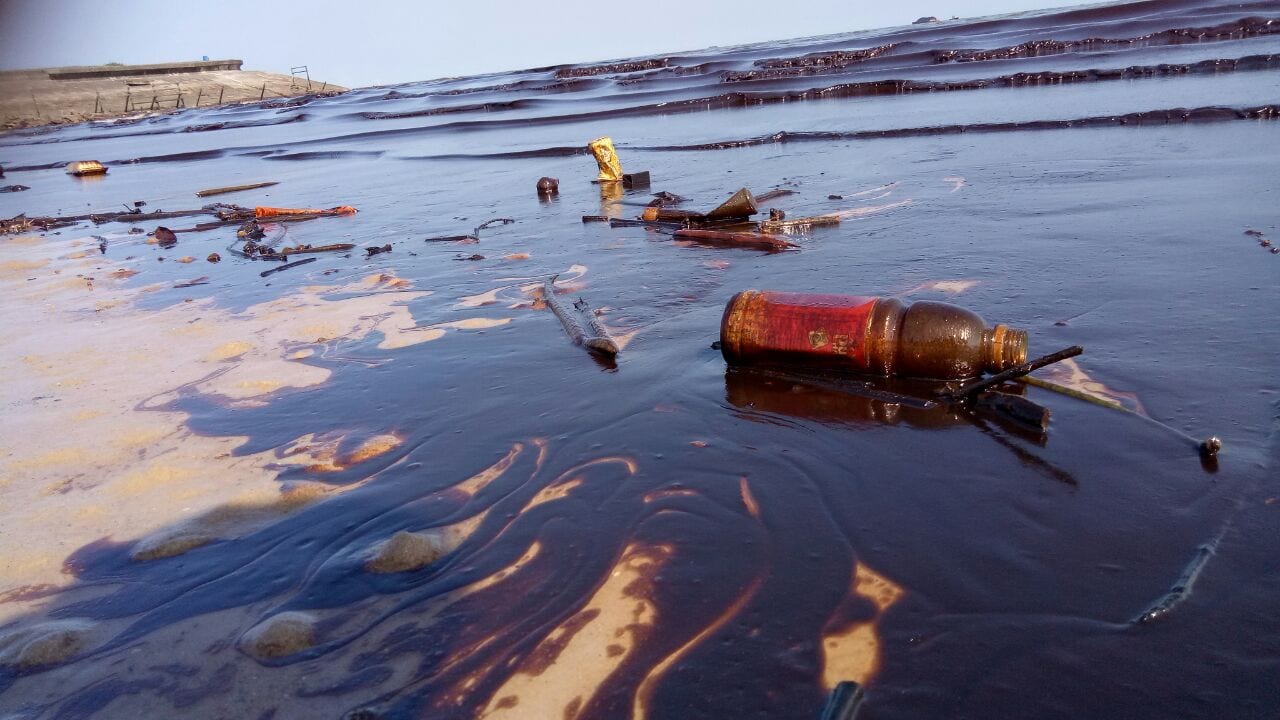
Related :Adam Laabs writes : A Single Oil Slick at Sea Really Cost
A layer only 0.1 millimeter thick is enough to block gas exchange
Oil does not vanish. Within hours of entering the water, it spreads across the surface, forming a film that can travel several kilometers per day. A layer only 0.1 millimeter thick is enough to block gas exchange between air and water, suffocating the upper layer of the sea and triggering oxygen depletion. Beneath this thin film, larvae and plankton die silently. As time passes, waves and currents emulsify the oil, driving it deeper into the water column, where it attaches to suspended particles or settles into sediments. The process that begins as a visible slick on the surface ends as a long-term chemical intrusion into the marine food web.
Bioaccumulation and the Ecological Debt
Petroleum-derived compounds, particularly polycyclic aromatic hydrocarbons (PAHs), are hydrophobic, persistent, and bioaccumulative. Marine organisms cannot metabolize them; they simply store them in fatty tissues and organs, where they disrupt endocrine and reproductive systems, damage cellular structures, and lead to chronic disease. Studies by the Woods Hole Oceanographic Institution revealed that decades after the 1978 “Amoco Cadiz” disaster, traces of oil remain detectable in sediments off the coast of Brittany. Certain mollusk species there still exhibit elevated concentrations of hydrocarbons. Oil does not “disappear” it changes state and location, but it never leaves the system.
The human food chain
These compounds inevitably enter the human food chain. FAO analyses have found measurable hydrocarbon residues in fish caught in both the North Atlantic and the Mediterranean. What begins as a technical malfunction at sea ends as a public health concern on land. The boundary between environmental contamination and food safety is far thinner than most people realize.
Technology That Stopped Evolving
The global response to oil pollution still relies largely on technologies developed in the 1980s, whose effectiveness rarely exceeds 25–30%. The most common among them granular sorbents are almost entirely unsuited to marine conditions. The sea is not a static surface. Wind, current, and wave dynamics cause the material to scatter within minutes. Much of it sinks; some drifts away; the rest disperses into suspension, creating an untraceable, uncontrollable mess. Once that happens, no one can accurately quantify how much oil was absorbed, how much remains in the water, or how much has settled in sediments. From a systems science perspective, such operations are not remediation they are the redistribution of pollution.
The cleanup becomes performative,
Granular sorbents also produce a false sense of completion. The visible surface sheen may disappear, but the contamination persists below. The cleanup becomes performative, not effective a gesture of effort rather than an act of resolution. The result is a cycle of underreported pollution that erodes both ecosystems and institutional credibility.
A Paradigm Shift: Controlled Absorption
A new approach must replace dispersion with containment and control. The AquaGuard system was developed precisely for this purpose: a nonwoven sorbent that selectively absorbs oil and fuel without taking in water, maintains full buoyancy after saturation, and can be recovered and recycled in its entirety.

The role of AquaGuard
AquaGuard is not simply more absorbent it is physically compatible with marine dynamics. It functions as a continuous, flexible surface that can be deployed within seconds from a vessel or shoreline. In roll form, it can be unfurled directly from the deck, forming a semicircular barrier that captures and immobilizes the spill. In sheet form, it stabilizes critical zones such as harbor entrances or shoreline turbulence areas. Even after saturation, the material floats, enabling full retrieval, weighing, and documentation. Each meter used and recovered is quantifiable, creating an auditable, closed-loop process with no residual contamination.
This is not an incremental improvement it is a structural correction. It turns emergency response from improvisation into measured environmental management.
Geopolitics and Systemic Risk
Marine pollution is not merely an ecological issue. It is a geopolitical one. The average age of global oil tankers now exceeds twenty years, and many operate under “flags of convenience,” beyond strict technical oversight. Combine this with heightened geopolitical tensions, restricted trade routes, sanctions, and intensifying storms, and the risk landscape becomes exponential. Each passing year without preventive systems in place increases the likelihood of large-scale spills and with them, multi-billion-dollar losses and decades of environmental recovery.
In this context, prevention ceases to be an ethical aspiration. It becomes a pillar of national and corporate security. The question is no longer whether we can afford to invest in readiness; it is whether we can afford not to.
Operational Responsibility
There is no rational argument against equipping every vessel with the means to contain an oil spill in its first minute. Safety culture in the maritime industry should mirror that of terrestrial transport: every car carries a fire extinguisher and first-aid kit, not because it burns daily, but because one day it might. Yet the majority of ships today sail without a single tool capable of immediate, mechanical containment of oil discharge.
AquaGuard was engineered for that precise interval the first minutes after a spill, when local action determines global consequences. The difference between a one-minute and a thirty-minute delay often marks the boundary between a contained incident and a regional disaster. From a technical standpoint, this is not innovation; it is basic operational logic.
The Cost of Indifference
Indifference has a price. It is measured not only in liters of oil, but in reputational loss, insurance disputes, ecological damage, and disrupted livelihoods. Every uncontained spill triggers economic aftershocks from the closure of fishing zones and tourist beaches to legal battles that last longer than the contamination itself. Indifference is the most expensive decision in any environmental equation.
Oil does not poison the ocean. Human inaction does. The hydrocarbons are neutral molecules until someone neglects maintenance, ignores aging infrastructure, or decides that prevention can wait until next quarter’s budget. Indifference turns physics into tragedy.
From Initiative to Standard
AquaGuard is not a campaign or a concept; it is a ready-to-implement preventive technology that should be as standard on every vessel as navigation lights or lifeboats. Implementation requires no complex infrastructure only a decision. A decision to move from reaction to anticipation. To place rolls of nonwoven material in accessible deck modules, deployable sheets in harbor units, and collection containers for post-recovery logistics. To treat the first minute as the decisive one.
This is not environmental activism. It is technical governance, based on measurable outcomes and verifiable data. Every spill prevented in the first minute saves hours of cleanup, millions in costs, and countless biological lives.
Conclusion
The maritime world stands at a threshold where speeches and declarations have lost their value. Effectiveness no longer resides in promises, but in preparedness. AquaGuard represents that readiness scientifically validated, economically viable, and operationally simple. Every port, every vessel, every operator dealing with oil-based products should integrate it into their emergency systems. Only then will the term “responsibility” mean more than a checkbox in a sustainability report .What’s poisoning the oceans isn’t oil. It’s our delay, routine, and tolerance for the status quo..The real question is not whether we can prevent spills we can. It is whether we will act in the first minute, not the last.
AquaGuard ,Adam Laabs,, Indifference, What’s Poisoning the Oceans, Oil, (IMO) ,(UNEP), collection containers ,Marine pollution , Cost of Indifference,Systemic Risk
You Might Also Like
Recommendation News
Shipping Lines
Xeneta 's report this week update shipping rates 14 February 2026
Shipping Lines
Scorpio Tankers sells two 2016 LR tankers and buys two newbuildings 18 December 2025
Ports
HPC to develop final business case for Port of Newcastle’s Clean Energy Precinct 06 November 2025
Marine Tech
Syria locks in 30-year BOT with Kuzey Star for $190m Tartus shipyard 18 January 2026
Incidents
IMB : Maritime piracy to increase in 2025 18 October 2025