This certification demonstrates the regulatory feasibility of the ship, serving as a meaningful step in advancing the transition of the existing fleet to alternative fuels, as bulk carriers of this size are widely operated today.
Tokyo – ClassNK has issued an approval in principle (AiP)*1 for the design concept of a retrofitted Kamsarmax bulk carrier, converting it from conventional fuel to methanol dual-fuel, jointly developed by TSUNEISHI SHIPBUILDING Co., Ltd. and Fonden Mærsk Mc-Kinney Møller Center for Zero Carbon Shipping*2.
The regulatory feasibility of the ship
This certification demonstrates the regulatory feasibility of the ship, serving as a meaningful step in advancing the transition of the existing fleet to alternative fuels, as bulk carriers of this size are widely operated today.
The design concept
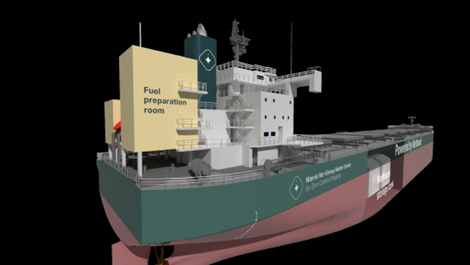
The design concept was developed as part of a project exploring the conversion of Tsuneishi’s Kamsarmax bulk carrier standard design to a methanol dual fuel configuration. Aiming to establish a model that could pave the way for a broader green transition within the medium-sized bulk carrier sector, the project is working through retrofit challenges, such as determining the location of the new methanol fuel tanks.
The design concept
ClassNK carried out a design review of the design concept based on “Part A Guidelines for Ships Using Methyl/Ethyl Alcohol as Fuels (Edition 3.0.0)” of the “Guidelines for Ships Using Alternative Fuels” and examined the risk assessment through HAZID. ClassNK issued AiP upon confirming the feasibility of key design, including the arrangement of methanol fuel tanks and fuel supply systems, in terms of regulatory compliance.
ClassNK will continually strive to contribute to advanced decarbonization initiatives through safety assessments and more.
Related : ClassNK: “Guidelines for Liquefied Hydrogen Carriers (Edition 3.0)
At the initial stage of designing
*1 At the initial stage of designing or before the specific target ship to be implemented is decided, the design is examined based on the existing regulations, such as international conventions and ship classification rules, and an Approval in Principle (AiP) is issued as proof of conformity with requirements.
Related : MOL Obtains AiP for LNG Carrier Installing Wind Challenger
It also prevents rework of regulatory aspects in the post-process, shortens the examination time at the time of class registration, and can be used as a technical basis for external appeal of the design status. For more information, visit our website.
The Mærsk Mc-Kinney Møller Center
*2 The Mærsk Mc-Kinney Møller Center for Zero Carbon Shipping is a not-for-profit, independent research and development center looking to accelerate the decarbonization of the maritime industry. Our organization participates as a Mission Ambassador. For more information, visit the website.
Image of a retrofitted methanol dual-fuel vessel (courtesy: TSUNEISHI SHIPBUILDING Co., Ltd.)
Press - Release
#ClassNK #AiP #Kamsarmax bulk carrier #Fonden Mærsk Mc-Kinney Møller#TSUNEISHI SHIPBUILDING# methanol #Zero Carbon Shipping
You Might Also Like
Recommendation News

Ports
DP World and Gulftainer, along with Contship, are in the running for Tarros. 09 September 2026
Marine Tech
HD Hyundai Signs $4 Billion Thoothukudi Shipyard MoU 24 April 2026
Shipping Lines
Maersk has confirmed a new major order for 26 large containerships 20 September 2026

Ports
Singapore port traffic rises in October as vessel and container volumes increase 15 November 2025