Capt. Francis Modozie writes: IMO Net-Zero Is Not Yet Law. Shipowners Cannot Afford to wait.
The IMO is preparing to revisit its draft global fuel-standard and emissions-pricing framework in December. Shipowners need operational readiness regardless of the outcome.
By Capt. Francis Modozie,
MNI | Master Mariner (Unlimited Tonnage) | Founder & Principal, SeaFleet Backbone LLC
Scope note: This article does not advocate for or against adoption of the proposed IMO Net-Zero Framework. It examines the regulatory status and the operational, commercial and workforce-readiness implications for shipowners and fleet managers.
Regulatory position verified: 3 October 2026.
Citation note: Numbered source markers correspond to the hyperlinked official references at the end of this manuscript.
2050 | 4 Dec 2026 | >5,000 GT | $100 / $380 |
IMO strategy: net zero by or around 2050 | Adjourned extraordinary MEPC session scheduled to resume, subject to MEPC 85 | Current draft scope for large oceangoing ships | Draft Tier 1 / Tier 2 remedial-unit prices for 2028-2030 |
International shipping is approaching another important regulatory decision point.
The International Maritime Organization's second extraordinary session of the Marine Environment Protection Committee, adjourned in October 2025, is currently scheduled to resume on 4 December 2026, subject to discussions at MEPC 85 immediately beforehand. At issue is the proposed IMO Net-Zero Framework: draft amendments to MARPOL Annex VI designed to combine a global marine-fuel greenhouse-gas standard with an economic compliance mechanism. [2]
The outcome remains uncertain. For shipowners and fleet managers, however, uncertainty at IMO does not remove the operational question. It sharpens it: can a fleet accurately measure, document and manage its greenhouse-gas exposure under whichever regulatory and commercial environment ultimately emerges?
That question reaches far beyond environmental compliance. It touches fleet investment, bunker procurement, voyage planning, charter-party allocation, machinery strategy, ship finance, crew competence and the quality of data moving between ship and shore. Decarbonisation is increasingly becoming a matter of fleet governance.
Where the negotiation stands
The overall direction was established in 2023. IMO's revised GHG Strategy calls for international shipping to reach net-zero greenhouse-gas emissions by or around 2050, taking different national circumstances into account. It established indicative checkpoints of at least a 20% reduction in total annual GHG emissions by 2030, striving for 30%, and at least 70% by 2040, striving for 80%, compared with 2008. [1]
The strategy also set an ambition for zero- or near-zero-GHG technologies, fuels and energy sources to represent at least 5% - striving for 10% - of the energy used by international shipping by 2030. [1]
The more difficult question has always been how those ambitions would be translated into mandatory international regulation. At MEPC 83 in April 2025, Member States approved draft amendments establishing the IMO Net-Zero Framework. Formal adoption was scheduled for the second extraordinary MEPC session in October 2025. Instead, the meeting was adjourned for one year.
Technical work continued. ISWG-GHG 22 met in London from 1 to 4 September 2026 to consider proposals addressing concerns with the draft MARPOL amendments. IMO's official summary records continuing negotiations and states that detailed implementation-guideline documents and further work on lifecycle-GHG assessment were deferred to ISWG-GHG 23, scheduled for 23 to 27 November. MEPC 85 follows on 30 November to 3 December, after which the adjourned extraordinary session is scheduled to resume on 4 December, subject to the outcome of MEPC 85. [2]
The distinction is important: the 2050 strategy exists; the proposed regulatory framework intended to help implement it has not yet been adopted.
Political agreement is still developing. Operational readiness cannot wait for it. |
What the current draft would do
The April 2025 draft would establish a new Chapter 5 of MARPOL Annex VI applying to ships of 5,000 gross tonnage and above, subject to the exclusions contained in the draft regulations. [4]
Its central measurement is the ship's annual GHG Fuel Intensity, or GFI. Unlike a system concerned only with emissions produced when fuel is burned onboard, GFI is calculated on a well-to-wake basis. That brings lifecycle emissions associated with the energy source into the compliance calculation. [3][4]
The draft establishes two trajectories: a Base Target and a more demanding Direct Compliance Target. The reduction factors start at 4% and 17% respectively in 2028 and increase through 2035, when the April 2025 draft reaches 30% and 43% relative to the 2008 GFI reference value. [4]
A ship performing better than the Direct Compliance Target could generate surplus units. Subject to the final rules, those units could be transferred, banked, or voluntarily cancelled. Ships falling short would face compliance deficits. [4]
Under the current draft, the initial remedial-unit prices for the 2028 to 2030 reporting periods are US$100 per tonne of CO2-equivalent for Tier 1 remedial units and US$380 per tonne for Tier 2 remedial units, calculated on a well-to-wake basis. The draft requires IMO to subsequently determine the pricing mechanism applicable from 2031 onward. [4]
Those numbers are important, but they should not be mistaken for settled law. The draft can still change. The more enduring strategic point is its architecture: measure lifecycle fuel intensity, establish progressively tighter performance thresholds, and attach economic consequences and incentives to performance. [3][4]
Regulation is not waiting for London
For operators trading to Europe, carbon-related regulation is already a commercial reality.
Maritime transport entered the EU Emissions Trading System in 2024. For emissions generated in 2026, the scheme reaches its fully phased-in level for covered emissions, while methane and nitrous oxide join carbon dioxide within ETS coverage. The geographical formula is commercially significant: 100% of covered emissions from voyages between EU ports and within EU ports are included, while 50% of emissions on voyages between an EU port and a non-EU port are covered. [5]
FuelEU Maritime has applied since January 2025. Rather than pricing each tonne in the same way as ETS, FuelEU limits the annual average lifecycle GHG intensity of energy used onboard qualifying ships calling at European ports. Its required reduction began at 2% in 2025, rises to 6% in 2030 and becomes progressively more demanding thereafter. [6]
An IMO delay therefore does not suspend regional obligations. For internationally trading fleets, the practical challenge is already broader than the fate of one IMO meeting. Owners increasingly have to manage overlapping global, regional, flag-state, charterer and financing expectations.
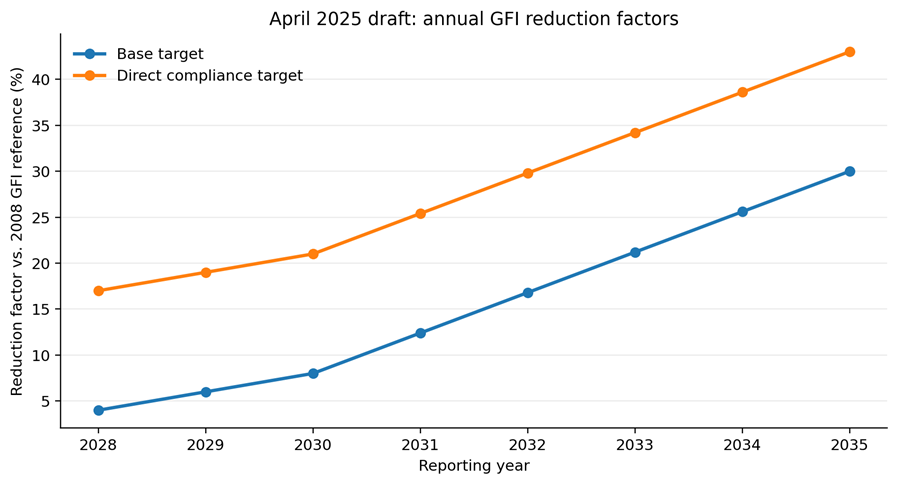
Figure 1. Annual GFI reduction factors in the April 2025 IMO draft. These values are draft regulatory parameters and are not yet legally binding. [4]
Capital providers are measuring performance too
Regulatory authorities are not the only institutions paying attention to shipping emissions. The Poseidon Principles currently bring together 36 financial institutions representing nearly three-quarters of global ship finance. Their methodology measures the climate alignment of participating institutions' shipping portfolios against trajectories linked to IMO's GHG ambitions. [7]
In 2026 the initiative expanded associate membership to include marine insurers and related organisations. This does not mean that one poor carbon-intensity number automatically produces a specific interest-rate increase. It does mean that emissions performance and the quality of underlying data are becoming increasingly visible within the institutions that finance and insure maritime assets. [7]
For owners, reliable emissions data is therefore becoming part of the broader commercial profile of the fleet.
Five readiness priorities for shipowners
1. Data integrity
Existing fleets already generate large quantities of information through IMO DCS, CII, SEEMP, bunker documentation, machinery records and, where applicable, EU MRV. The next challenge is not simply gathering more data. It is ensuring that the information is consistent, traceable and capable of independent verification when financial consequences are attached to it.
2. Fuel and asset strategy
Owners considering newbuildings, life-extension programmes, retrofits or major machinery investments should examine how much fuel and technology flexibility today's decisions preserve. This does not require predicting a single winning future fuel. It requires avoiding unnecessary technological lock-in while understanding the vessel's likely trading profile, remaining economic life and available infrastructure.
3. Commercial allocation of responsibility
Charter parties, bunker-procurement arrangements and management agreements will increasingly need to address questions that were once primarily operational: Who determines the fuel? Who controls speed and routing? Who owns or benefits from a compliance surplus? Who carries a deficit generated by a commercial instruction? The current IMO draft itself recognises operational responsibility by referring to decisions concerning fuel, cargo, route and speed when addressing recovery of compliance-related costs. [4]
4. Verification readiness
Shipping has always operated through evidence - statutory certificates, bunker delivery notes, engine records, logbooks, survey reports and maintenance histories. Decarbonisation adds another evidence chain. Fuel provenance, lifecycle-emissions characteristics, energy use and compliance calculations must ultimately connect the physical fuel entering the ship with the verified regulatory record ashore.
5. Crew competence
Alternative fuels change the operational risk profile of a vessel. Methanol, ammonia, hydrogen, battery systems and other emerging solutions introduce different requirements for containment, toxicity management, fire response, bunkering, emergency procedures and technical competence. IMO has issued generic interim training guidance for alternative fuels and new technologies, and in 2026 issued fuel-specific interim guidance for methyl/ethyl alcohol and ammonia. The energy transition will therefore succeed or fail partly through the competence of the people expected to operate the new technology. [8]
Readiness matrix: what management should be able to answer
| Readiness area | Management question | Evidence to have ready |
| Data | Can we reproduce our GHG calculation from source records? | Fuel records, DCS/MRV data, verification trail |
| Assets | Do current investments preserve fuel and technology flexibility? | Lifecycle plan, retrofit options, risk register |
| Contracts | Who controls and pays for compliance-sensitive decisions? | Charter-party and management clauses |
| People | Can the crew safely operate the selected technology? | Training matrix, drills, competency records |
| Governance | Who owns the fleet-level readiness picture? | Named accountability, dashboard, escalation process |
The United States dimension
The United States remains formally opposed to the current draft framework. In August 2025, the U.S. Departments of State, Commerce, Energy and Transportation issued a joint statement opposing the proposal and characterising it as a 'global carbon tax'. In August 2026, Federal Maritime Commission Chairman Laura DiBella again stated that the framework in its current form should be rethought before international acceptance and implementation, while calling for a broader range of alternative fuel pathways. [9][10]
IMO describes the proposal differently: as a performance-based framework built around GHG-intensity limits, tiered compliance payments, surplus units and a dedicated Net-Zero Fund. These are competing policy characterisations of an unresolved international negotiation. [3]
This article takes no position on which policy approach should prevail. For operators, the practical point is narrower: a U.S.-connected shipping company may operate foreign-flag tonnage, call at ports in jurisdictions with their own carbon rules, charter to multinational cargo interests, borrow from international lenders and purchase bunkers across multiple regulatory environments.
The eventual legal exposure of any particular vessel will depend on the final IMO text, MARPOL implementation, flag-state obligations, regional measures and trading pattern. Owners should therefore distinguish political position from operational exposure and obtain legal advice where treaty or contractual applicability is uncertain.
Citation note: Numbered source markers correspond to the hyperlinked official references at the end of this manuscript.
Operational principle: Political disagreement over a regulation does not automatically remove a globally trading vessel from the commercial, contractual or regional requirements surrounding that regulation. |
From the bridge to the boardroom
After decades in vessel operations, I see the maritime energy transition as more than a question of which fuel eventually powers the ship. It is a question of whether the organisation can connect vessel condition, machinery performance, voyage planning, bunker procurement, emissions information, crew competence, commercial contracts and shore-side governance.
A regulation may be negotiated in London. Its underlying evidence is created elsewhere - at the bunker manifold, inside the engine room, in machinery records, through the noon report, within the voyage plan and in decisions exchanged between vessel and shore management.
That is why operational experience matters. A decarbonisation strategy that exists only in the boardroom is incomplete. A compliance programme that exists only onboard is equally incomplete. The strongest fleets will be those in which the two are connected.
Shipowners do not need to predict today exactly what Member States will decide when negotiations return to IMO later this year. They do need to know whether their fleets can respond intelligently to whatever follows.
Net zero may still be under negotiation. Readiness should not be.
For shipowners and fleet managers: where is your greatest readiness gap today - fuel strategy, data verification, vessel technology, crew competence or commercial contracts?
About the author
Capt. Francis Modozie, MNI is a Master Mariner (Unlimited Tonnage) with more than 25 years of international maritime and vessel-operational experience. He is Founder & Principal of SeaFleet Backbone LLC, a maritime advisory and readiness business supporting shipowners, operators and maritime organisations across marine operations, compliance, vessel governance, workforce readiness and digital maritime systems.
Contact: contact@seafleetbackbone.com | Website: seafleetbackbone.com
You Might Also Like

Recommendation News

Marine News Room
The historic duel with the Drawn Sword of God is part of the story of Hormuz, the "Master of the Strait". 30 March 2026
Shipping Lines
Drewry : Cancelled Sailings Tracker 21 December 2025
Shipping Lines
Xeneta: 'Long-term container freight rates do not cover the cost of the conflict in the Middle East. 05 May 2026
Seafarers
Francis Modozie writes: The Commercial Cost of a Port State Control Detention 01 June 2026
Shipping Lines
MOL installs the first rigid wind sails on an LNG carrier. 18 May 2026