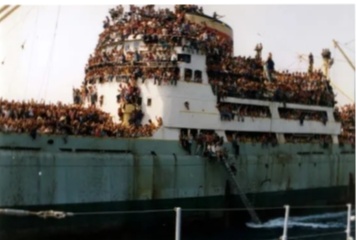
Italy later began repatriating Albanians to their country en masse after confirming its inability to accommodate such a large number of migrants, while simultaneously tightening controls on its maritime borders.
Every year, tens of thousands of boats carrying undocumented migrants arrive on Italian shores, primarily from North Africa and the Middle East. In 2025, Italian authorities estimated that around 66,000 irregular migrants arrived via the Mediterranean Sea. This figure is significantly lower than the 2023 peak, when around 157,000 migrants arrived.
The events of the summer of 1991
By comparison, the events of the summer of 1991 remain one of the most dramatic scenes of mass migration in modern Italian history. On one day alone, more than 20,000 Albanian migrants arrived in Italy on a single cargo ship. Albania lived under the strict communist rule of Enver Hoxha for decades. He imposed near-total isolation on the country, curtailing relations with the outside world while simultaneously tightening internal control and restricting freedoms.
A phase of gradual political and economic disintegration in 1990
The country experienced a severe economic downturn during this period, exacerbated by political disputes with both the Soviet Union and China, as well as with Tirana. By the end of the 1980s, the communist bloc in Eastern Europe had begun to collapse, and Albania entered a phase of gradual political and economic disintegration in 1990. During this time, Albanians faced severe food shortages, frequent power outages, and soaring unemployment and inflation, prompting many to consider emigration by any means possible.
Albanians saw Italy as a place of opportunity, offering a 'better life'.
Conversely, many Albanians saw Italy as a place of opportunity, offering a 'better life'. Through Italian television channels that could be received in Albania, residents saw shops overflowing with goods and modern cars, and a completely different lifestyle. As the internal crisis worsened, emigration to Italy became a collective dream, and thousands of Albanians began attempting to cross the Adriatic Sea in small boats and fishing vessels.
On 7 August 1991,
On 7 August 1991, the Albanian cargo ship Flora arrived at Durrës port from Cuba, carrying a cargo of sugar cane. When rumours spread that the ship was bound for Italy, thousands of Albanians rushed to the port, breaching security barriers and forcibly boarding the vessel. The ship was completely filled to capacity, making it almost impossible to move on deck, and the passengers forced the crew to sail to Italy.
Shock in Bari
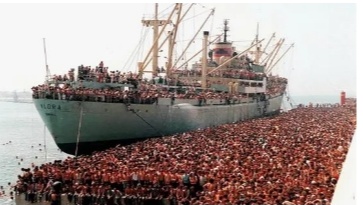
Upon arrival at the Italian port of Bari, the Italian authorities were shocked by the scene: a cargo ship carrying more than 20,000 people in dire humanitarian conditions. Images of the ship spread around the world, becoming a symbol of the collapse of the communist regime and people's desire to flee to Western Europe.
Related : 40 migrants missing after recovering bodies, 6 died in the Med
Despite initially rejecting the large number of migrants, the Italian authorities were later compelled to allow them to disembark due to the worsening health and humanitarian situation on board.
The majority of the Albanian people were taken to the stadium in Bari,
The majority of the Albanian people were taken to the stadium in Bari, where they were provided with food, water, and medical care, all of which was made possible by heavy police and military security. As temperatures soared, helicopters dropped water bottles onto the pitch amid fears of deaths from thirst and exhaustion.
The Flora incident.
However, having confirmed its inability to accommodate such a large number of migrants, Italy later began repatriating Albanians to their country en masse, while simultaneously tightening controls on its maritime borders. One of the most significant events in the history of modern migration in Europe, and an early symbol of the humanitarian crises associated with mass migration by sea, was the Flora incident.
#Flora incident.#Albanian people #port of Bari #Durrës port #Albanian migrants #Italian shores #Europe
You Might Also Like
07 October 2025

16 October 2025
Recommendation News
Shipping Lines
Reasons for Asia's reliance on Middle Eastern oil - A report 04 March 2026
Marine Tech
IMO : New video series launched: Highlighting the vital role of women in ship recycling 17 January 2026
Marine News Room
A new secure maritime corridor for commercial shipping across Hormuz 12 April 2026
Marine Tech
The US indicated that consider an alternative to the IMO-run shipping climate fund. 04 September 2026
Shipping Lines
TT Club :Innovators in Cargo Handling Safety Honoured 09 October 2025