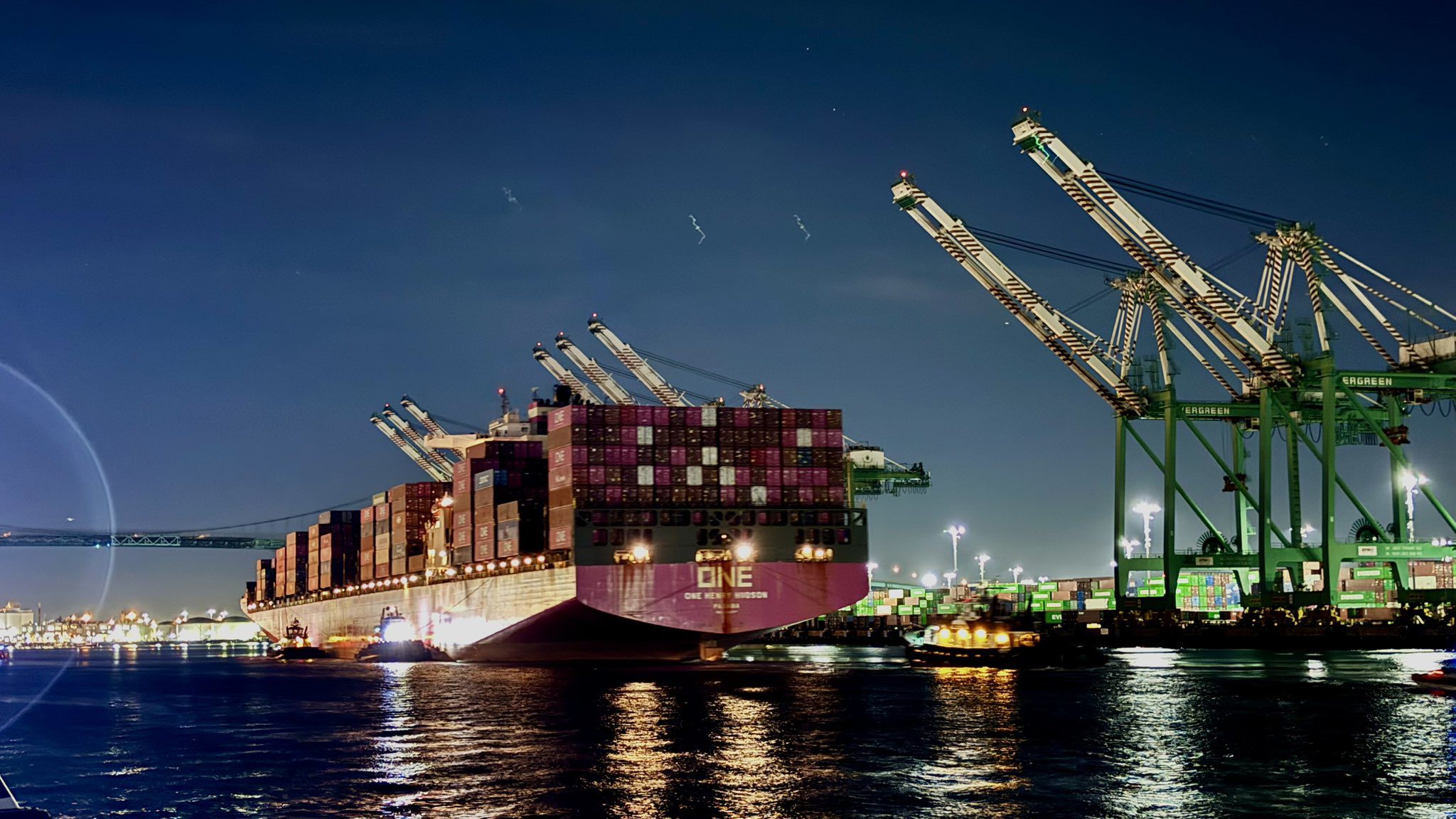
The Unified Command oversaw a complex operation to shift the vessel back to the berth. where the Vincent Thomas Bridge, which crosses Los Angeles Harbor
At last with the firefighting efforts completed and the fire aboard the vessel reportedly contained, the ONE Henry Hudson was shifted late on November 26 from the anchorage one mile offshore back to a berth in the Port of Los Angeles. The plan calls for offloading the containers that were affected by the fire, as well as others that were scheduled for discharge when the fire began on November 21.
Under the direction of the Unified Command,
Under the direction of the Unified Command, crews returned the ONE Henry Hudson to Yusen Terminal at the Port of Los Angeles late Wednesday night. The vessel’s arrival marks a key transition into the next phase of the response, where longshore labor and salvage crews will begin offloading cargo and managing waste.
A complex operation to shift the vessel back
The Unified Command established by the U.S. Coast Guard, and the Port of Los Angeles, oversaw a complex operation to shift the vessel back to the berth. The Port of Los Angeles reported that due to vessel operations, the Vincent Thomas Bridge, which crosses Los Angeles Harbor linking San Pedro with Terminal Island, would be closed. The Unified Command also said that firefighting assets would be alongside while the vessel was shifted from the anchorage and would remain on standby once the vessel arrived back at its berth.
Vessel Transit, Offload and Waste Management
The vessel was escorted back to the terminal within a safety zone supported by Los Angeles Port Police, Los Angeles Fire Department fire boats, the U.S. Coast Guard, and tug operators. Salvage teams also remained on continuous watch for any flare ups throughout the transit to monitor for any remaining heat signatures. None were reported
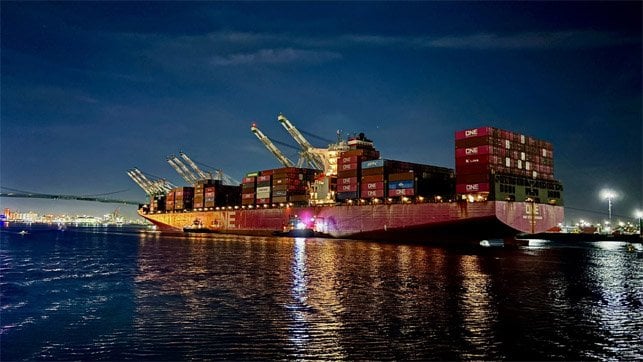
The inspection of the vessel’s cargo,
ONE Henry Hudson was secured before midnight at the Yusen Terminal at the Port of Los Angeles. The salvage crew will be working with the longshore labor crews in the next phase of the operation. This will involve the inspection of the vessel’s cargo, which will then be categorized as damaged by fire, damaged by water, or not damaged.
The reports emphasized that all the hazardous materials have been contained on the vessel, including the firefighting water. Crews had reconfirmed the vessel’s stability before the move because of the amount of firefighting water in the no. 3 hold. The plan is to pump the water off the ship for treatment on shore. They are also continuing air monitoring on the ship and in the port.
Before the move could begin, longshore crews completed lashing of the ship’s cargo on Wednesday. The vessel had been discharging cargo in the port when the fire began, and it was evacuated. It had been moved to the anchorage early on November 22.
A team from Donjon-SMIT is managing the salvage operation. There still have not been any confirmed reports on how many containers were in the affected area of the vessel. The ship has a capacity of 9,100 TEU when full, but images show fewer containers were aboard when the fire began.
initially reported the fire as an electrical incident.
The crew aboard the containership initially reported the fire as an electrical incident. An investigation is planned into the cause of the fire.
“The initial firefighting response, relocation of the vessel to a remote anchorage, and recent movement back to the pier were all critical operations that required careful coordination and execution,” said U.S. Coast Guard Capt. Stacey Crecy, Incident Commander. “I am grateful for all of the partners who came together to make it a success. Now, a new phase begins where damaged cargo and firefighting water will be properly removed and disposed of. I’m confident the team will accomplish the work ahead safely and efficiently.”
Related : New details : Electrical fire that broken out on cargo ship at Port of Los Angeles

The next phase of operations involves the inspection of the vessel’s cargo, which will then be categorized as damaged by fire, damaged by water, or not damaged. All waste onboard—including firefighting water—will be disposed of properly per an approved waste management plan.
The ILWU has played a critical role in reinforcing the vital link
“This collaboration not only exemplifies the strength of partnership among various agencies, but also reaffirms our collective commitment to safeguarding our communities,” said Gary Herrera, ILWU Local 13 President. “For 90 years, the ILWU has played a critical role in reinforcing the vital link between domestic and international trade, demonstrating why dockworkers are essential to our national security and commerce. It is a proud moment for the ILWU, as we stand united in our mission to ensure safety and security on the waterfront. The enduring relationships we build today will undoubtedly strengthen our capabilities for the challenges of tomorrow.”
Continued Air Monitoring
L.A. Port Police continue to conduct active air monitoring. All readings remain below state and federal action thresholds, and no impacts have been detected outside the established safety zone. Real-time air monitoring results are available on the Port’s public air quality site here. It is noteworthy that The cause of the incident remains under joint investigation by the U.S. Coast Guard and the National Transportation Safety Board.
L.A. Port Police , U.S. Coast Guard, ONE Henry Hudson, Port of Los Angeles , Gary Herrera , ILWU , Stacey Crecy ,Yusen Terminal , firefighting efforts ,
You Might Also Like
19 December 2025
Recommendation News
Shipping Lines
"K" Line - KME & KMSM Family Day 2026 Held in Singapore 01 October 2026
Marine News Room
Exclusive with Gavin Allwright Secretary General of IWSA (3-3) 06 October 2025
Shipping Lines
“K” LINE Acquires Full Ownership of “K” Line Wind Service 10 April 2026
Marine Tech
ABS : Appointment of Ronald J. Rábago as Senior Vice President of Government Services 04 May 2026
Ports
Port of Oakland Cargo Volume Rebounds in March as Vessel Calls Rise 23 April 2026