By : Raul Villa Caro
Secretario de la Fundación “EXPONAV”
Alongside the F-111 Bonivaz frigate, which will be officially registered in the Navy's official fleet (LOBA) in the coming years, the current fleet comprises nearly one hundred vessels, some of which are relatively unknown. There are training sailboats, following in the footsteps of the Spanish jump ship JSdE, which has spent years training sailors during its initial voyages at training centers.
Patrol boats and auxiliary vessels
Numerous patrol boats and auxiliary vessels also operate in the shadow of the more famous and media-focused ships, some of which have been operating for decades. Perhaps the least well-known of these is the "grey grandad," the patrol boat Cabo Ferradera, the second oldest vessel in the Navy after the JSdE.
The auxiliary vessel Alerta
The auxiliary vessel Alerta is another interesting example. Launched at the German shipyards in Rostock, it was delivered to the German Navy in 1985 under the name Yasmund. At the end of 1991, it was acquired by the Navy and entered service a year later with the Spanish Navy's fleet (LOBA) under the name Alerta and flag number A-111. The ship's main mission is logistical transport between national and international ports, although for years it has been known as our "spy" ship.
The "Official List of Naval Vessels (LOBA).
All of the Spanish Navy's currently operational vessels are listed in a publication called the "Official List of Naval Vessels (LOBA)." Or rather, almost all of them, since the current edition dates back to 2023 (replacing the previous 2020 edition). The 76 pages of this publication provide information on the characteristics of our ships, including their type or class, home port, commissioning date, and even their launch location and date.

Impressive photographs of the vessels
All this data is accompanied by impressive photographs of the vessels, showcasing aircraft carriers, frigates, submarines, amphibious assault ships, supply ships, and landing craft. The list also includes light transport and logistics vessels, rescue ships, auxiliary vessels, tugboats, mine countermeasures vessels, naval operations vessels, patrol boats, hydrographic and oceanographic vessels, and training ships
The inland patrol vessel Cabo Fradera (P-201)
The inland patrol vessel Cabo Fradera (P-201) is the second oldest ship in the Spanish Navy, after the Juan Sebastián Elcano. It is also known as "Grey Grandfather," a nickname it acquired after the decommissioning of the Contramestre Casado in 2025. This transport ship has served in the Navy for over 40 years, and 72 years of operational life when including its previous service as a merchant vessel.
A hero of Callao
The inland patrol vessel Cabo Fradera is named in honor of Petty Officer Esteban Fradera y Bohijas, a hero of Callao, who was martyred in the mutiny that occurred during the Spanish squadron's stay in the port of Callao, Peru, in February 1865.
The new "Fradera"
The "Fradera" is based at the naval command pier on the Mineo River, located in the noble and loyal city of Tui (Pontevedra). It is a much-loved vessel in the city. It has been in service since September 10, 1963, the year it replaced the gunboat of the same name that had been based in the city from 1928 to 1963. The ship is [length missing].

The new "Fradera" is a small, shallow-draft vessel, 17 meters long, 4 meters wide, and with a displacement of 28 tons. Its crew consists of seven men and women (one officer, two warrant officers, a first-class corporal, and three seamen). It was built by the Bazán National Shipyard at the La Carraca shipyard (Cádiz) during 1961 and 1962. She traveled to Vigo on the transport ship "Almirante Lobo," and from there she proceeded to Tui.
The primary mission
Its primary mission is to monitor and enforce fishing, hunting, and sporting activities conducted in the international section of the River Minue (TIRM) by vessels of any flag and individuals of any nationality. The vessel operates for approximately 140 days a year, intensifying its patrols between December and April, the peak seasons for eel and lamprey fishing. Its other duties include monitoring and observing any construction or activity on the banks and within the TIRM canal that could affect navigation, thereby preventing potential vessel accidents.
In addition to river patrols, the ship also conducts maritime safety exercises with other entities (the Civil Guard, Customs Control, the Galician Regional Government, and others), and even with Portuguese authorities. The area is known for its events commemorating our patron saint, Our Lady of Carmen (including a river procession), events honoring Saint Telmo (patron saint of Tui), and schoolchildren's baptisms at sea.
Related: Raul Villa Caro : Navy’s training ship-“Juan Sebastián de Elcano”

Anita Sanchez Bandal,
Anita Sanchez Bandal, our current boat captain at the Ferrol military shipyard, is also stationed in Tui. Anita recalls that, back when she was captain of the patrol boat "Cabo Fradera," the local fishermen were convinced that the ship's captain was the ship's captain—a tall, powerfully built man with a beard. They couldn't imagine it was her. Anita Sanchez herself also notes that she regularly patrolled in the semi-rigid inflatable boat to monitor fishing activity, and when she issued a fine, the fishermen would sometimes say, "I'll talk to the captain," to which she would reply, "But which captain?" Even so, they still believed it was the tall, bearded one.
Out of curiosity, I would like to point out that the four current military pilots in Ferrol (Fernando Mendizabal, Pedro Izquierdo, Eduardo Bernal, and Anita Sanchez herself) were piloting "Cabo Fradera".
Raul Villa Caro ,Anita Sanchez Bandal ,F-111 Bonivaz frigate, "Fradera", Cabo Fradera (P-201) , Spanish Navy , (LOBA) ,ship JSdE, longest-serving naval vessels
You Might Also Like

Recommendation News

Marine Tech
ABS Approves Remote Control Functions from Hanwha Ocean for FPSOs 03 December 2025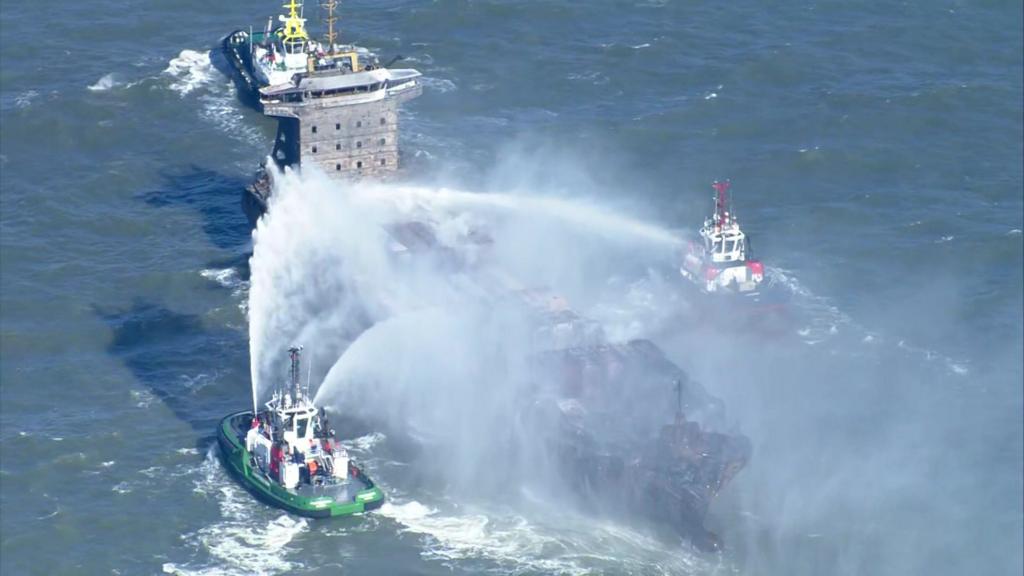
Incidents
Cargo Ship collides oil tanker off UK coast, causing fire disaster ( Photos + Video ) 16 October 2025
Incidents
Italy : More than two tons of pure cocaine seized at the port of Genoa 09 January 2026
Marine News Room
US Judge Rejects Trump Administration's Halt of Wind Energy Permits 09 December 2025
Yachts&Cruises
Msc cruise : Into the Record Books with Longest Line of Lego®ship 07 October 2025